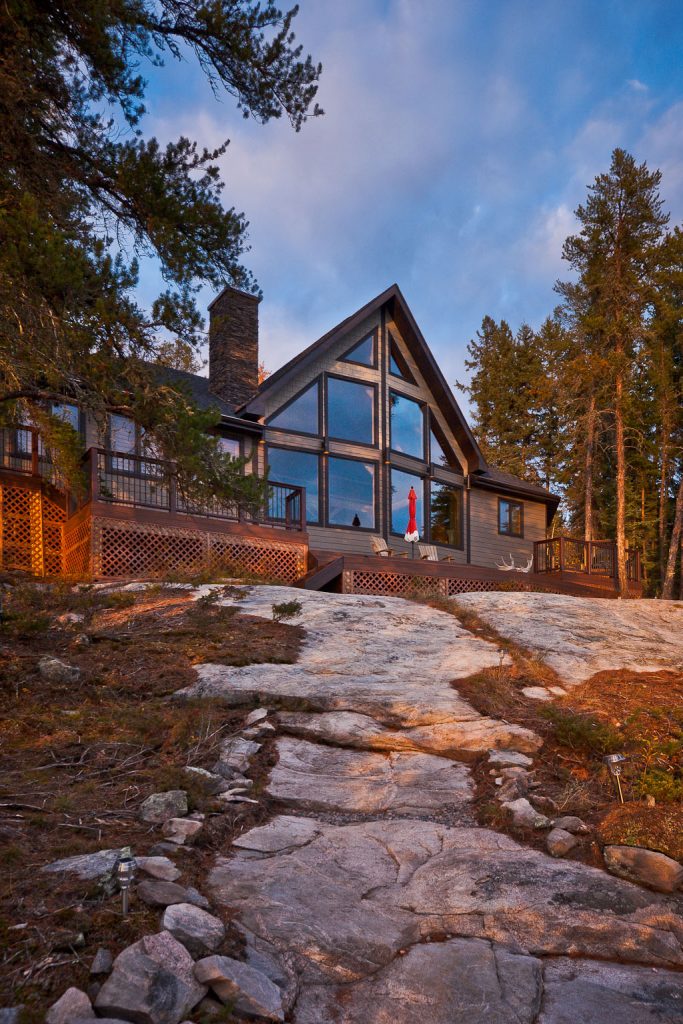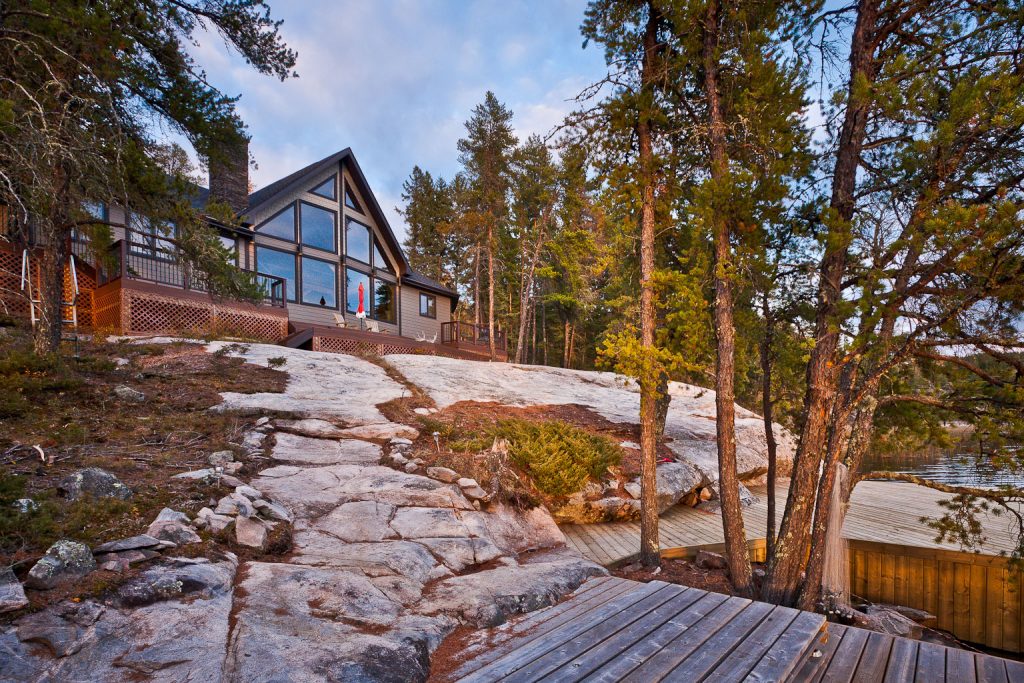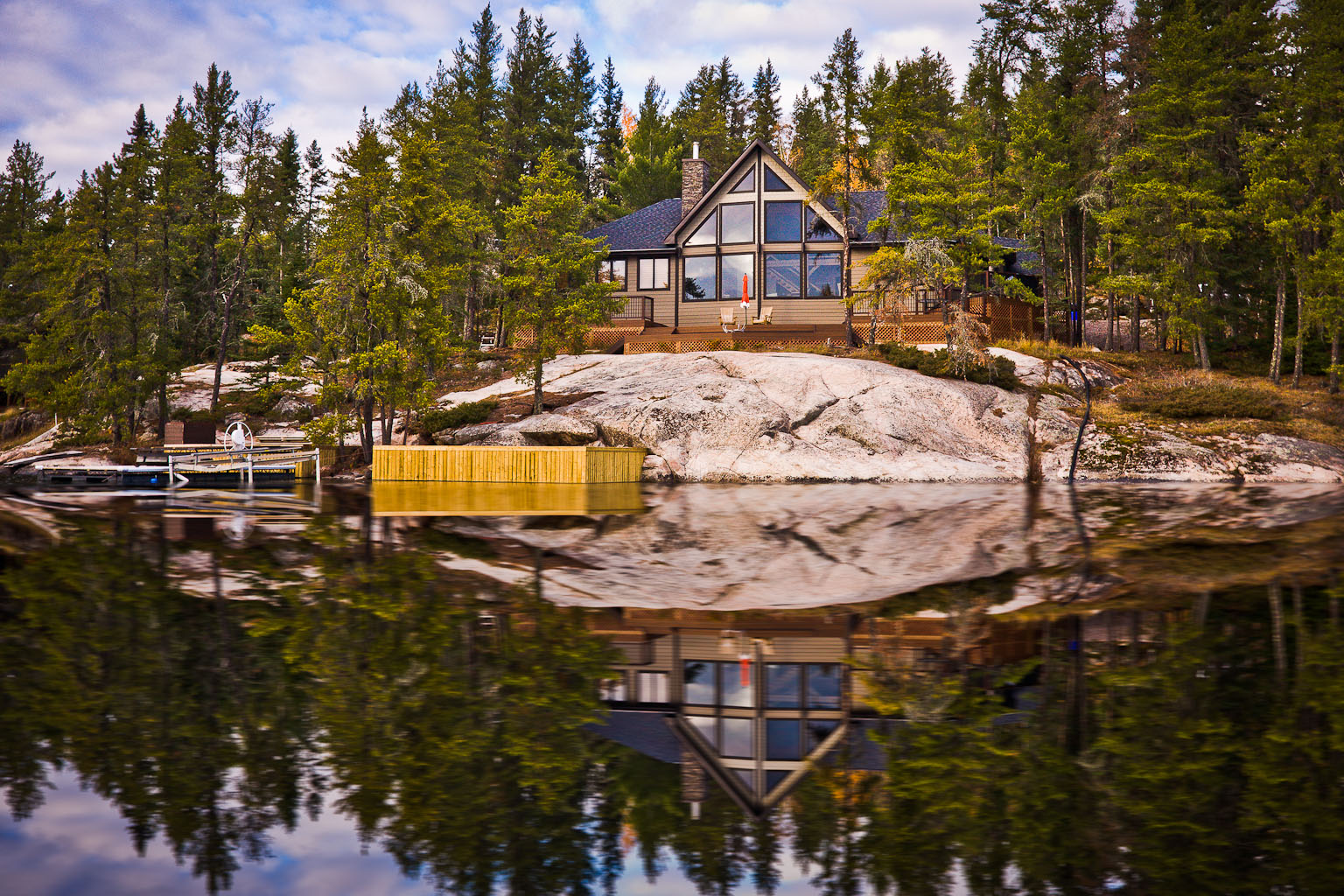
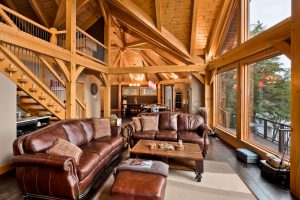
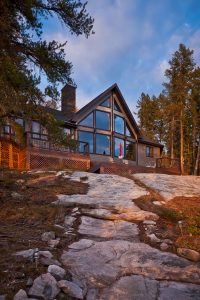
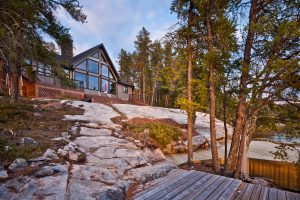
Whiteshell Escape is positioned on a rocky outcrop directly adjacent to the lake. Granite-based sites introduce both advantages and constraints. Rock provides stable bearing capacity but requires mechanical anchorage rather than conventional spread footing embedment.
Foundation engineering considerations include:
-
Drilled and epoxied anchor rods into granite substrate
-
Shear key integration where concrete interfaces with bedrock
-
Drainage detailing to prevent hydrostatic pressure against foundation walls
-
Frost protection at exposed edges
Because the residence is elevated and lake-facing, wind uplift and lateral wind pressure must be evaluated at higher-than-sheltered exposure categories.
Continuous load paths from roof diaphragm through timber posts into anchored foundation plates are essential.
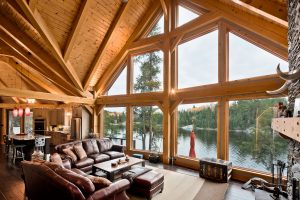
Prow Front Great Room and Glazing Integration
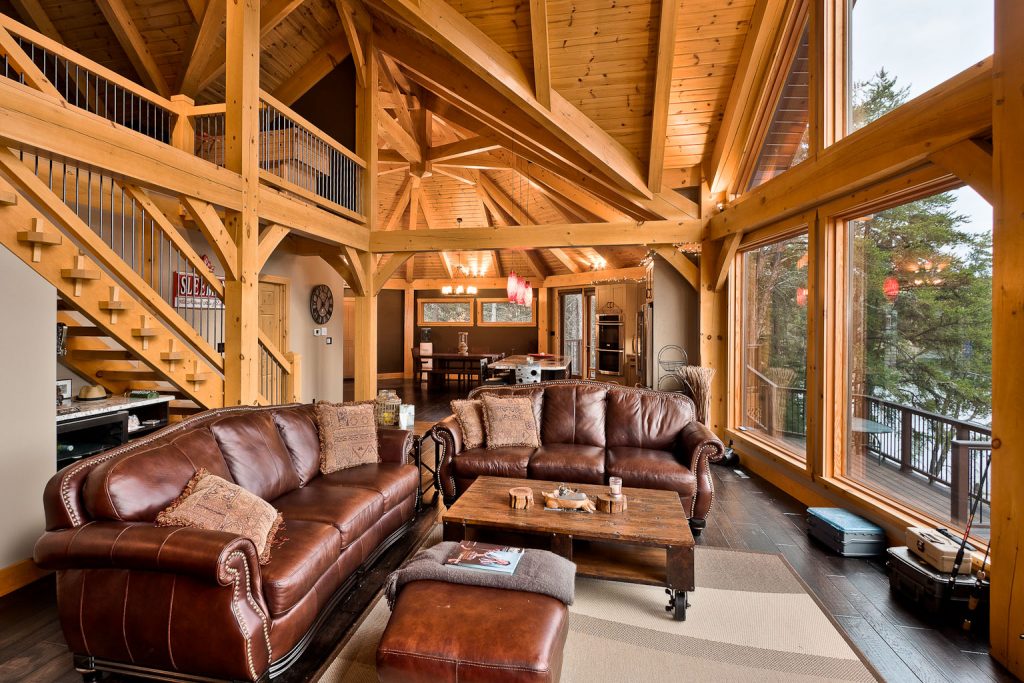
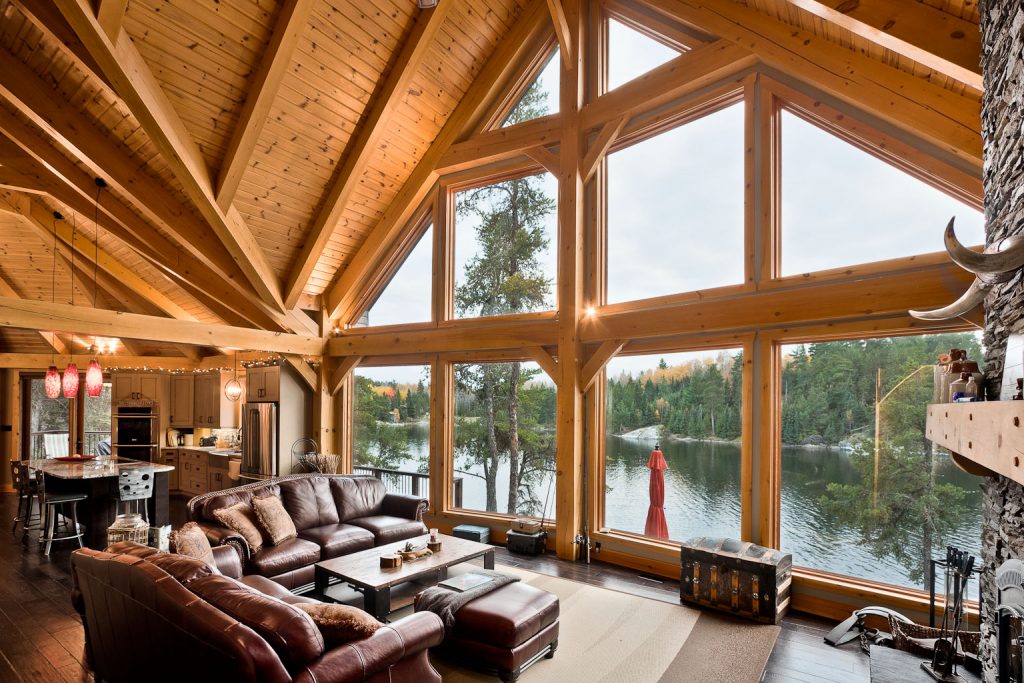
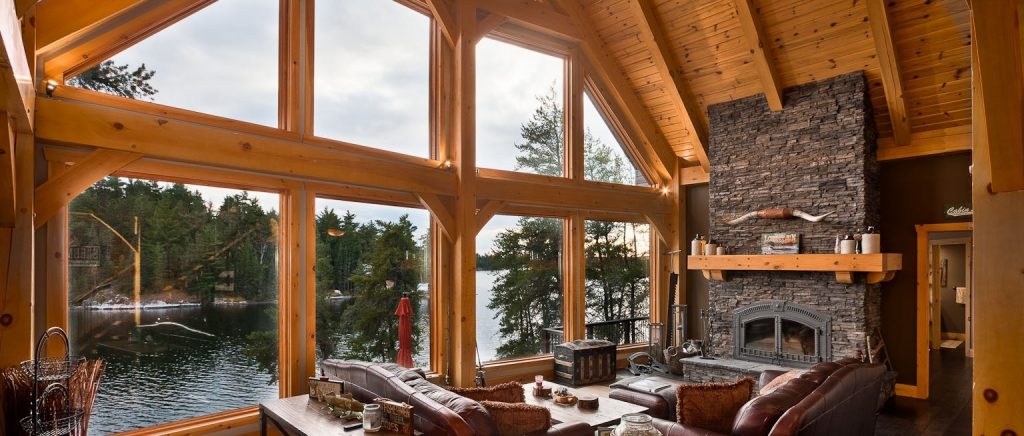
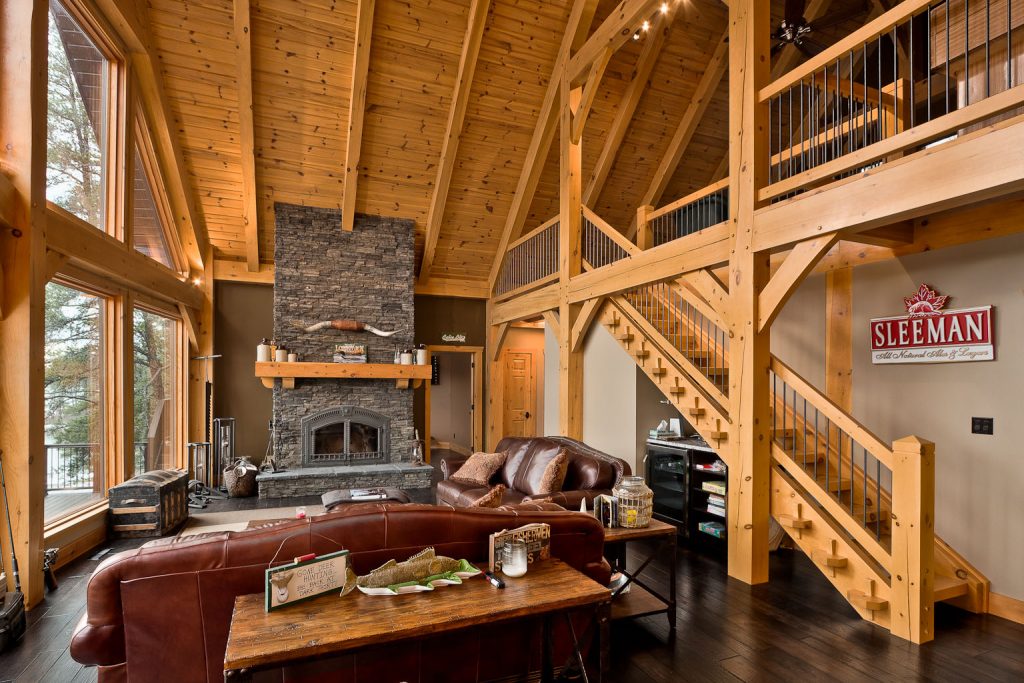
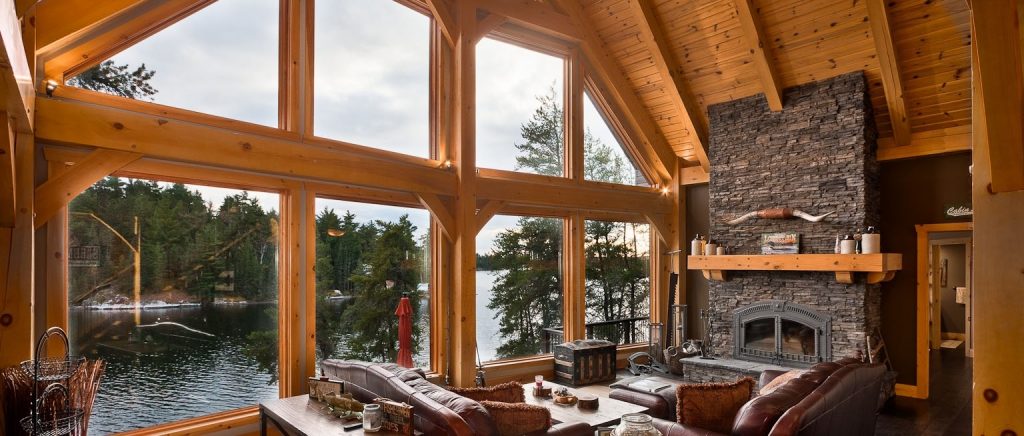
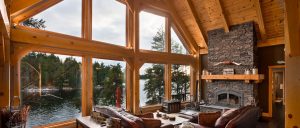
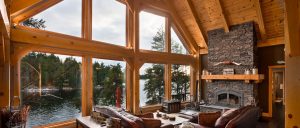
The main living area features a slight prow front with large picture and rake-head windows spanning from timber post to timber post.
Structural implications of prow geometry include:
-
Converging roof planes concentrating load at the prow apex
-
Increased wind exposure at lake-facing elevation
-
Reduced wall shear area due to expansive glazing
Engineering measures include:
-
Reinforced timber headers above full-height windows
-
Post alignment directly over foundation anchorage
-
Uplift-rated hold-down hardware
-
Shear wall placement in adjacent structural zones
Deflection limits are carefully controlled to protect glazing seals and prevent stress transfer into window frames.
Hammer Beam and Fireplace Integration
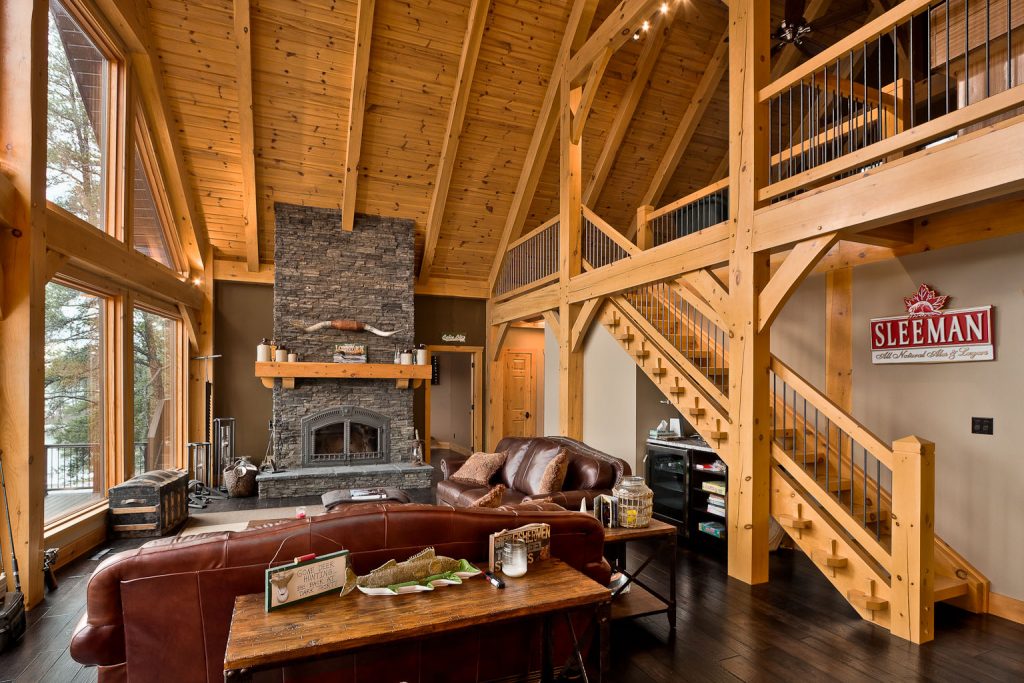
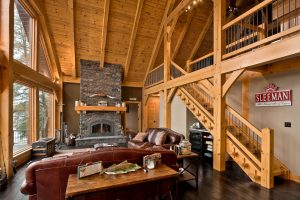
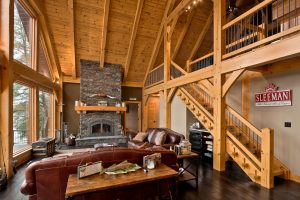
The great room includes a large cultured stone fireplace with a timber mantle. Masonry introduces significant dead load.
Structural coordination includes:
-
Reinforced floor framing beneath hearth
-
Direct load transfer to foundation support
-
Thermal separation between fireplace masonry and timber frame
The timber mantle is mechanically anchored while preserving movement tolerance due to seasonal shrinkage.
Hexagonal Kitchen and Billiard Space: Radial Framing Mechanics
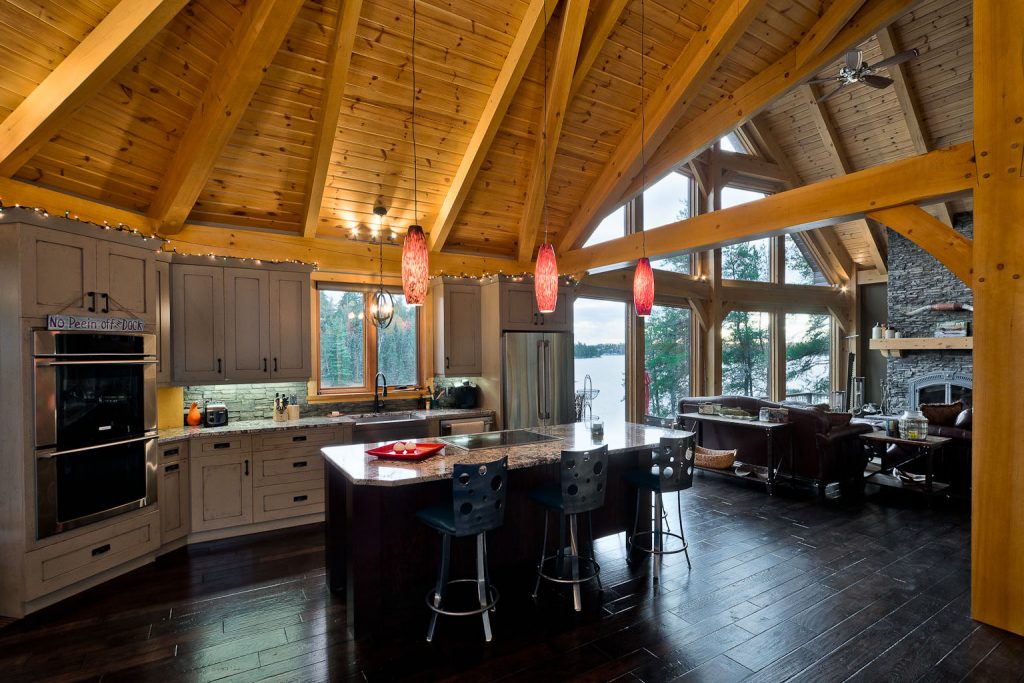
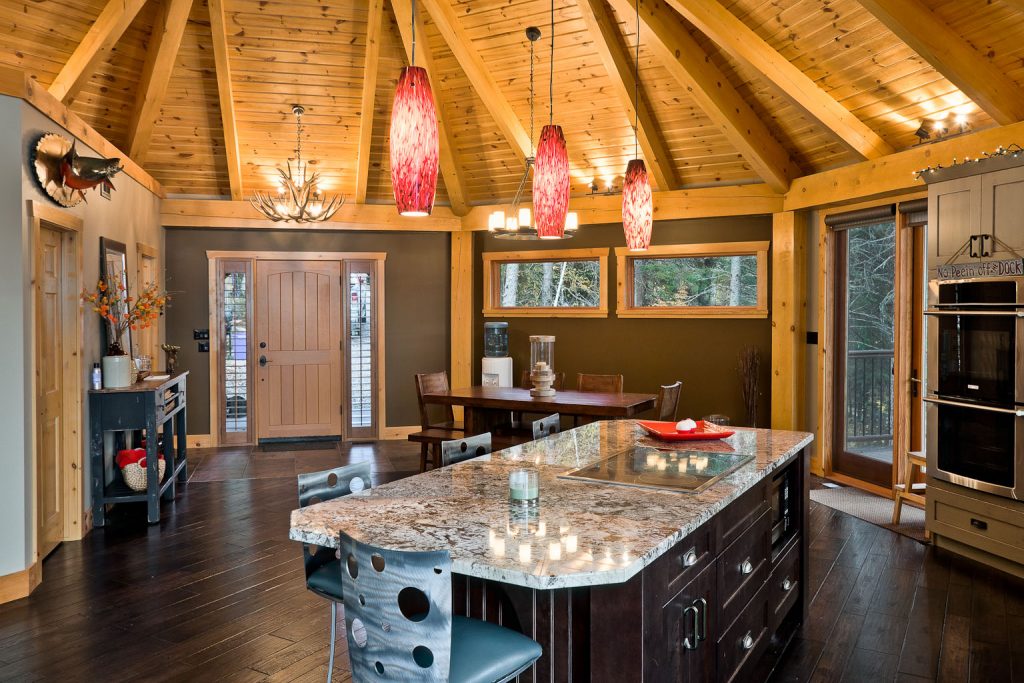
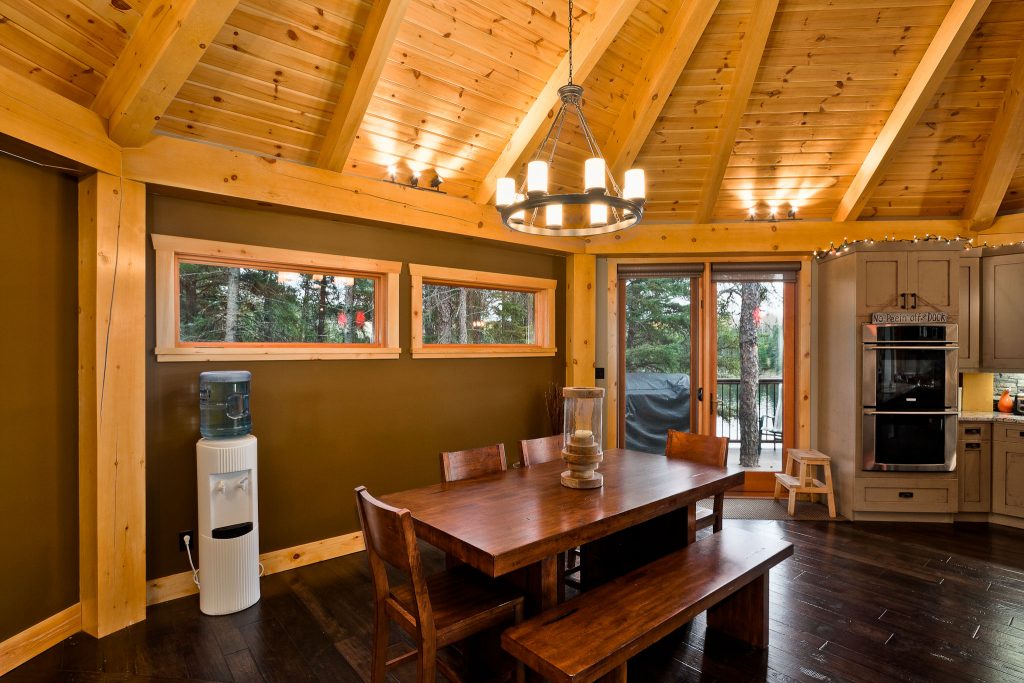
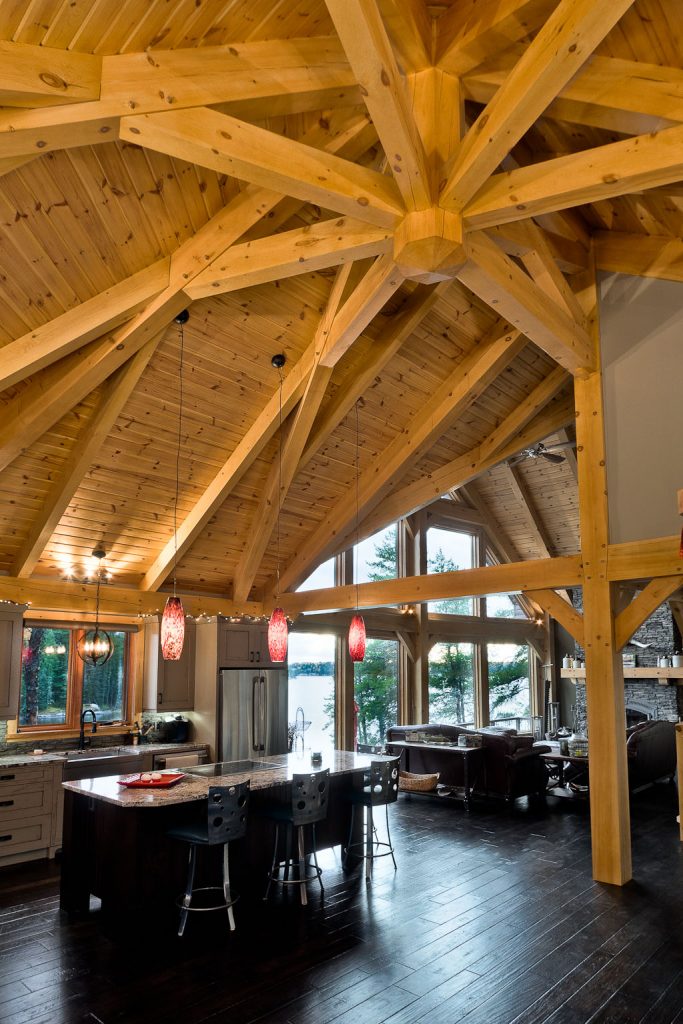
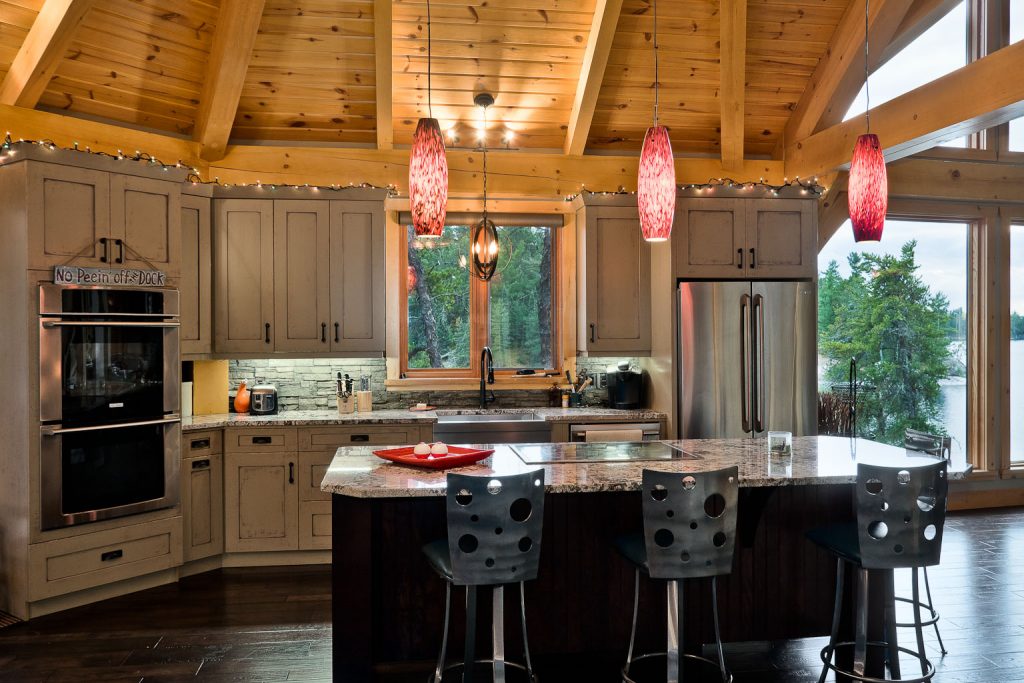
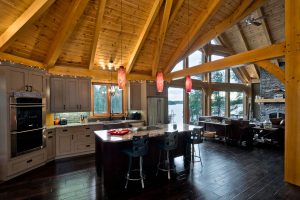
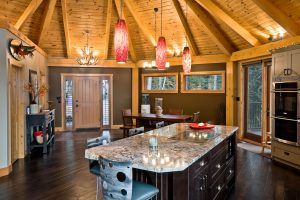
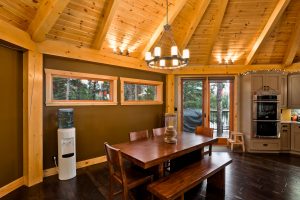
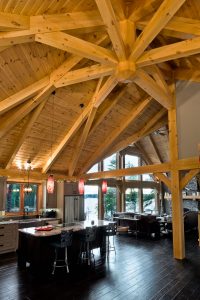
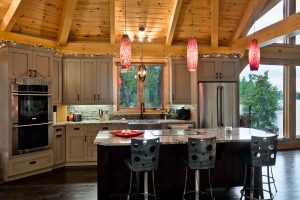
Connected to the great room is a custom hexagonal kitchen space incorporating a billiard table. The roof structure features a large central boss pin with fanning jack rafters.
Structural Behavior
Radial framing distributes compressive forces from rafters toward the central boss pin. The boss pin functions as a compression hub.
Engineering considerations include:
-
Multi-directional load convergence at boss pin
-
Balanced distribution of rafter thrust to perimeter posts
-
Snow drift accumulation at roof intersections
Each jack rafter is sized to resist bending stress and axial compression.
The hexagonal geometry requires precise fabrication tolerances to ensure equal load distribution and avoid eccentric loading at connection points.
Floor framing beneath the billiard table is reinforced to maintain level tolerance and limit vibration.
Multi-Tiered Lakeside Deck System
The lakeside elevation features a multi-tiered deck configuration descending toward the water.
Engineering considerations include:
-
Joist sizing for occupant live load
-
Lateral bracing against torsional movement
-
Uplift-rated post anchorage
-
Corrosion-resistant connectors
Because deck levels vary in elevation, differential load paths must be evaluated independently.
Drainage slopes and flashing prevent moisture accumulation and protect structural interfaces.
Gable Details and Covered Entry
Gable detailing and covered entry structures incorporate king post trusses with curved struts.
King Post Mechanics
-
Compression in rafters
-
Tension in king post
-
Thrust resolved through tie beam
-
Shear resistance at joint interfaces
Curved Strut Considerations
Curved members experience combined axial and bending stress. Increased member depth compensates for reduced section modulus at curved profiles.
Connection detailing resists rotation and shear at truss nodes.
Covered entry canopies must be engineered for snow load accumulation and wind uplift.
Conventional Bedroom Wing Integration
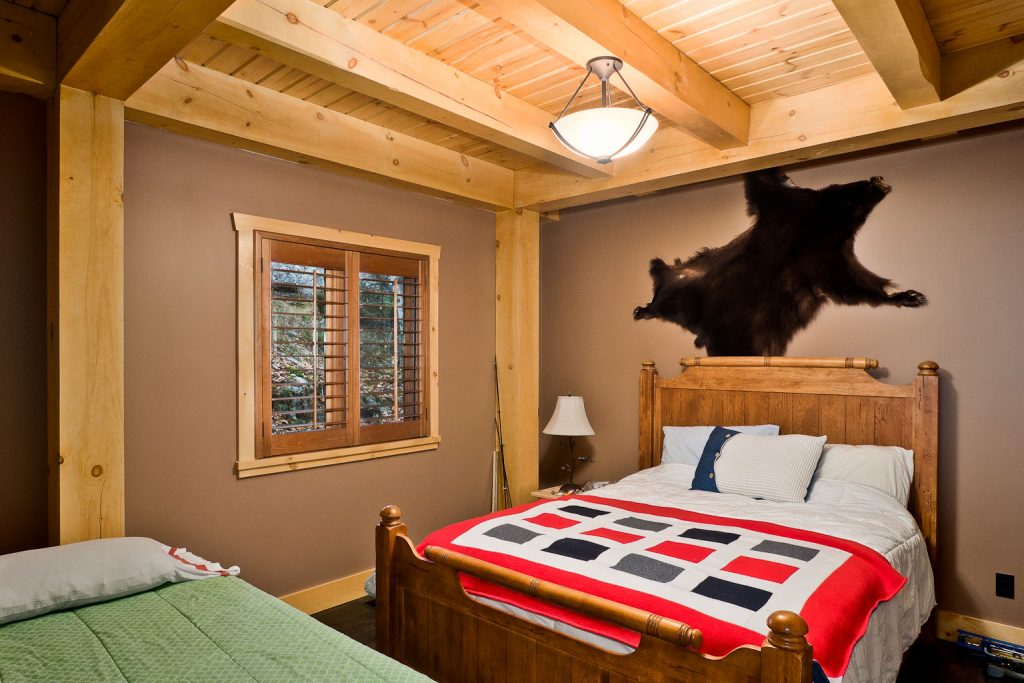
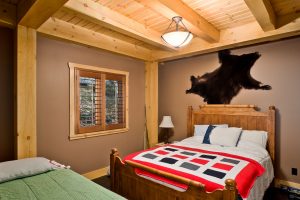
The bedroom wing opposite the kitchen is conventionally framed. This hybrid approach concentrates heavy timber framing in primary volumes while optimizing cost and mechanical routing in secondary spaces.
Structural coordination includes:
-
Reinforced bearing interfaces between timber and stud framing
-
Continuous roof diaphragm action
-
Moisture isolation at framing transitions
Load stacking remains vertically aligned to preserve foundation integrity.
Half Loft and Vertical Load Stacking
A half loft overlooks the main area. Structural implications include:
-
Reinforced loft floor framing
-
Guardrail anchorage into timber posts
-
Alignment of loft supports with primary structural grid
The loft contributes diaphragm stiffness and ties opposing roof planes together.
Finish Protection and Durability
All timber framing is finished with Sansin ENS UV Clear Optimum.
Protective finish objectives:
-
UV resistance
-
Vapor permeability
-
Surface moisture reduction
End grain sealing and proper flashing are critical due to exposed lakeside conditions.
Environmental Load Considerations
Whiteshell exposure introduces:
-
Snow accumulation and drift at roof intersections
-
Wind uplift across open lake surface
-
Freeze-thaw cycling
-
Elevated humidity
Structural countermeasures include:
-
Continuous load paths from ridge to footing
-
Reinforced prow and hexagonal roof connections
-
Uplift-rated anchors drilled into granite
-
Ventilated roof cavity
Creep deformation in long-span beams and radial rafters is incorporated into serviceability calculations.
Structural Summary
Whiteshell Escape demonstrates advanced timber engineering through:
-
Granite-anchored foundation system
-
Slight prow front with reinforced full-height glazing
-
Hexagonal kitchen with central boss pin and fanning jack rafters
-
Multi-tiered lakeside deck system
-
King post trusses with curved struts at entry and gables
-
Hybrid integration with conventional bedroom wing
The project combines complex roof geometry, radial framing mechanics and defined load path continuity to achieve structural reliability in a high-exposure lakefront environment.