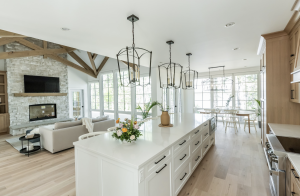
The South Shore lake home demonstrates controlled integration of modern interior aesthetics with exposed heavy timber framing. The project is not an aesthetic contrast between minimalism and rustic wood expression. It is a structural system where timber elements maintain defined load paths while contributing to spatial cohesion and material continuity.
The interior volume relies on engineered timber trusses, distributed load transfer, and material alignment to balance visual lightness with structural integrity. Exterior elements reinforce the timber frame identity while operating under different environmental constraints such as wind exposure, precipitation management, and thermal cycling.
Main Living Area: Scissor-Braced Trusses and Structural Geometry
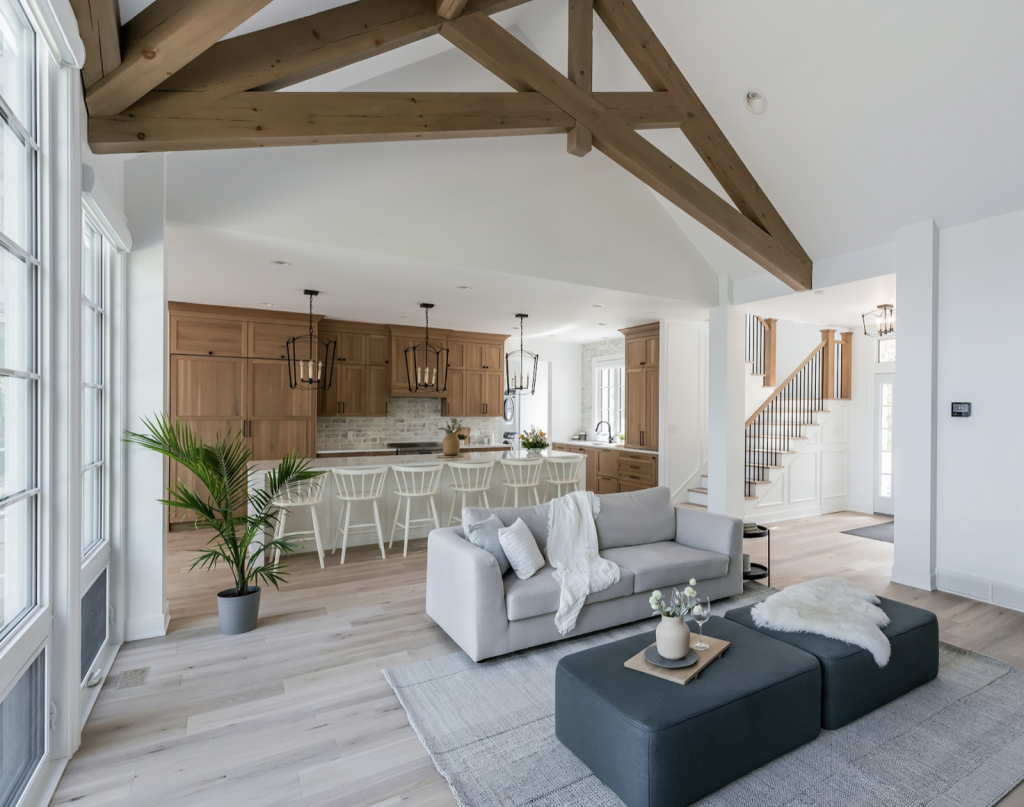
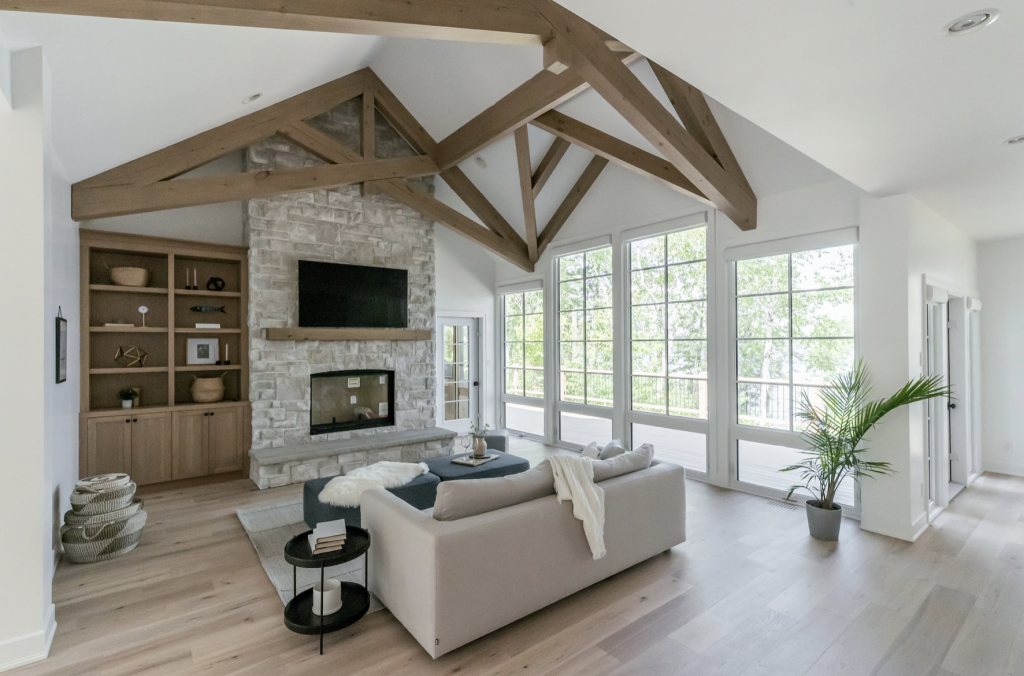
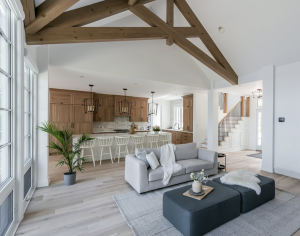
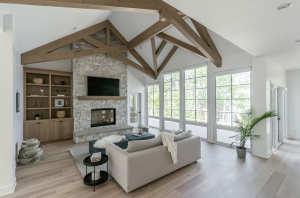
The primary structural feature within the main living space is the scissor-braced timber truss assembly. Unlike conventional king-post or queen-post systems, scissor trusses modify bottom chord geometry to create increased interior ceiling height while maintaining roof load support.
From an engineering perspective, scissor-braced trusses perform the following functions:
-
Transfer roof dead load and snow load into vertical posts
-
Resist lateral thrust generated by roof pitch geometry
-
Reduce bending moment at mid-span
-
Maintain dimensional stability under sustained loading
The angled bottom chords redistribute compressive and tensile forces along predictable load paths. Connection detailing must account for axial force vectors at brace intersections. Traditional mortise and tenon joinery or concealed steel plates are selected based on required shear capacity and long-term creep resistance.
Timber moisture content at installation is controlled to reduce shrinkage-related joint stress. Creep deformation under sustained roof load is considered during sizing to maintain serviceability limits.
Material Continuity and Thermal Interaction
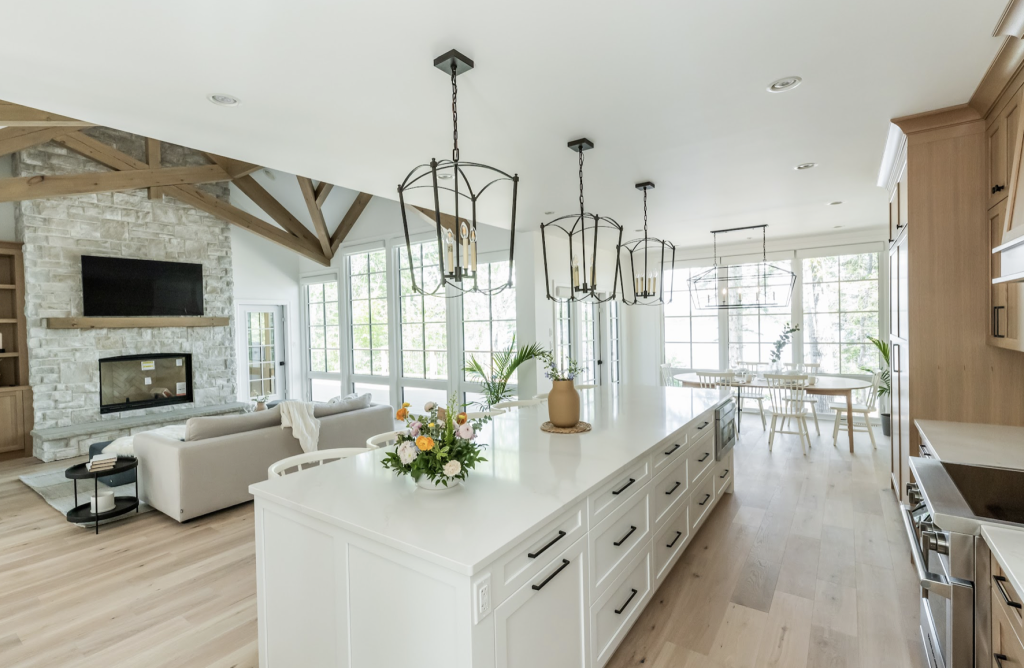
The truss system visually aligns with interior finishes including cabinetry, mantle detailing, and fireplace stone. This alignment is not superficial. It reinforces continuity between structural mass and interior envelope.
The fireplace introduces thermal mass within the living space. Stone elements moderate short-term temperature fluctuation through heat absorption and gradual release. Timber components adjacent to the fireplace are detailed with appropriate clearance to combustibles and thermal separation to prevent localized drying and shrinkage.
The interaction between timber and conditioned interior air requires humidity management. Seasonal moisture cycling influences dimensional stability. Mechanical ventilation and vapor control layers within the building envelope are coordinated to protect exposed structural members.
Sunroom Transition: Full Wood Envelope and Environmental Physics
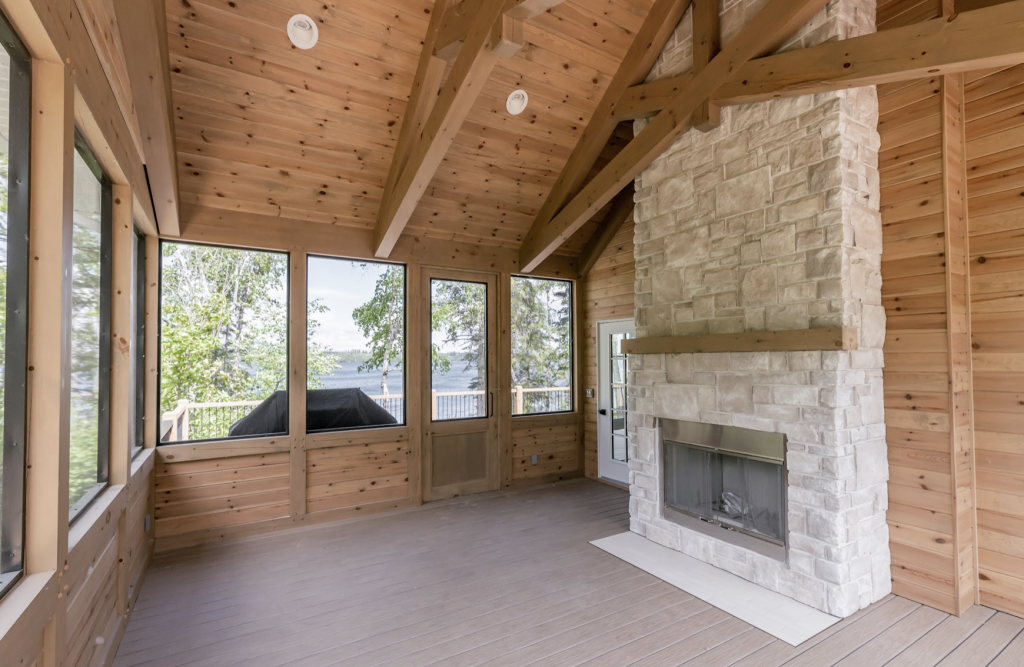
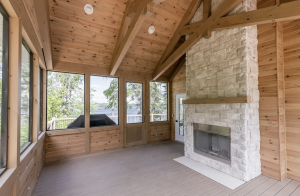
The adjoining sunroom extends the scissor-braced truss system into a space characterized by full wood wall and ceiling treatment. Structurally, this continuity maintains uninterrupted load transfer across the expanded footprint.
Sunroom environments experience amplified solar gain due to increased glazing area. Thermal performance considerations include:
-
Solar heat accumulation
-
Potential condensation at glazing interfaces
-
UV exposure impact on wood surfaces
Roof ventilation above the sunroom ceiling mitigates condensation risk. Air sealing at timber penetrations through the envelope prevents convective heat loss. Glazing orientation relative to lake reflection is evaluated to control excessive solar gain.
The full wood envelope introduces additional thermal inertia compared to drywall systems. Wood mass contributes modest buffering capacity but remains sensitive to prolonged moisture exposure. Surface finishing systems must accommodate vapor permeability while protecting against UV degradation.
Exterior Timber Expression and Structural Performance
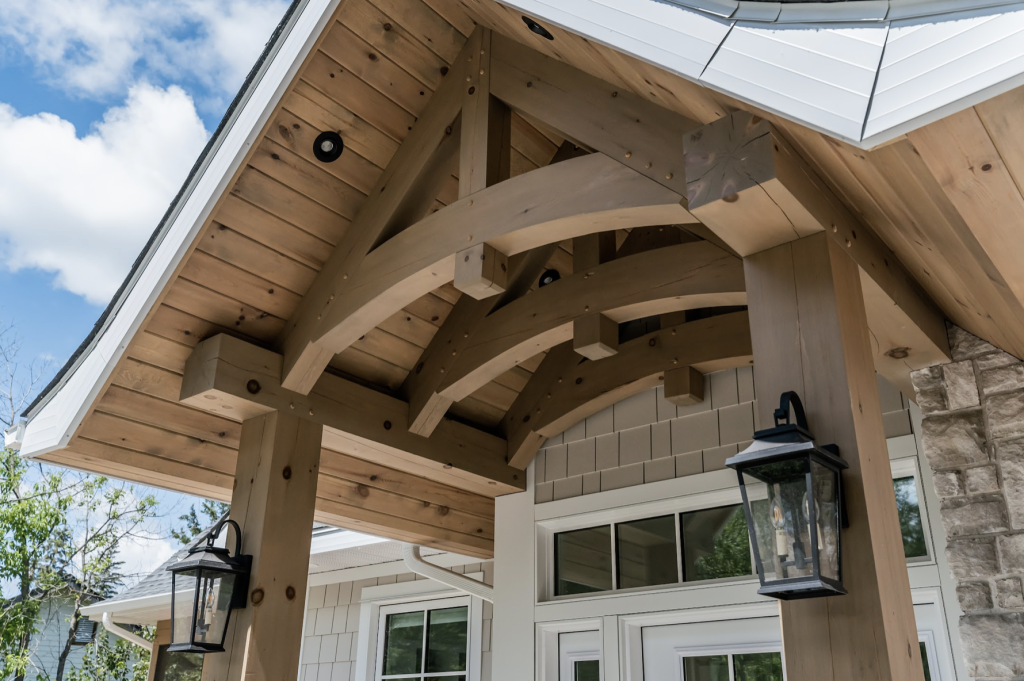
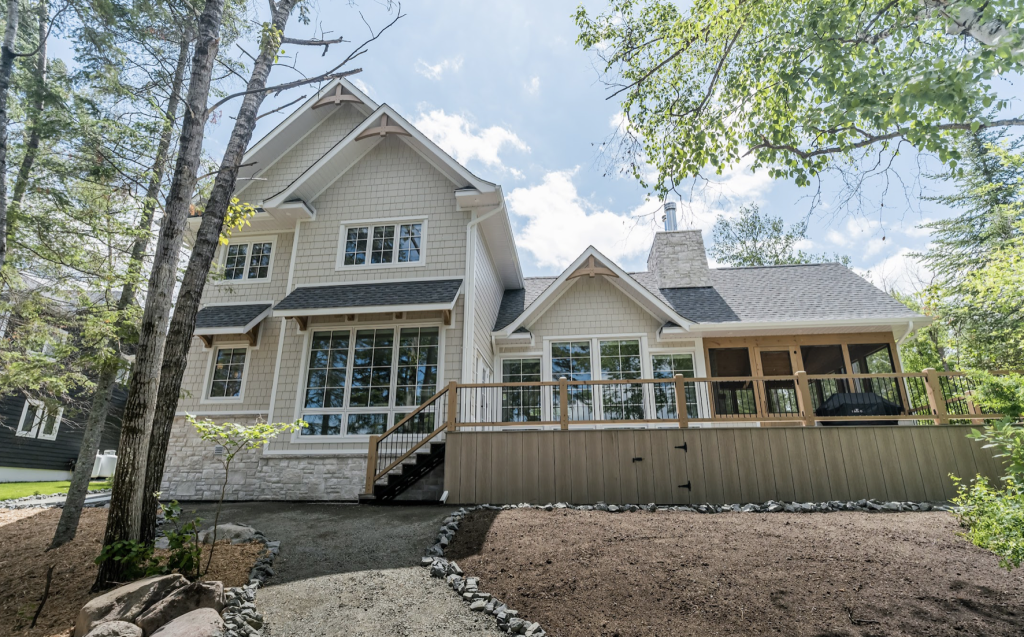
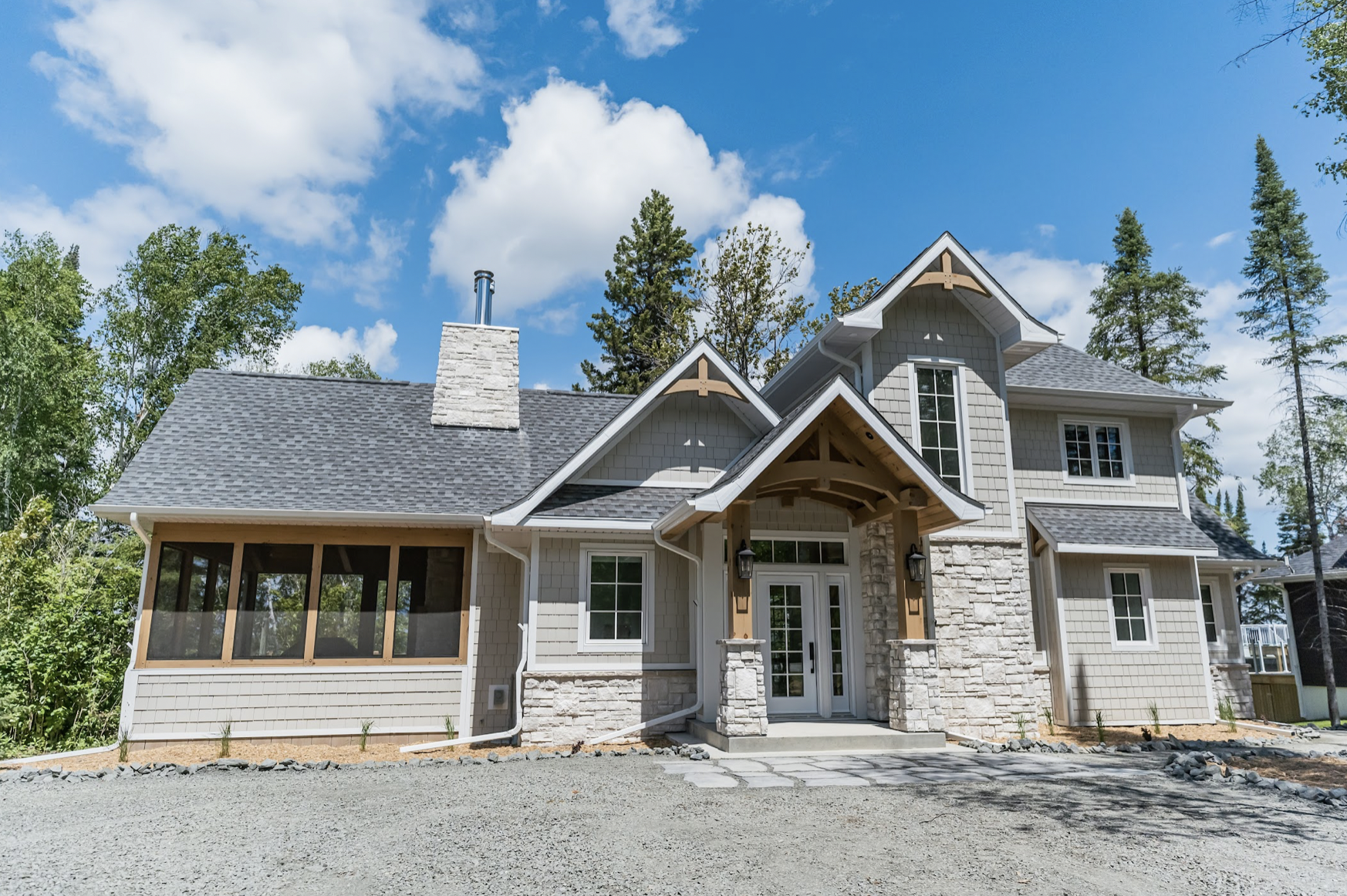
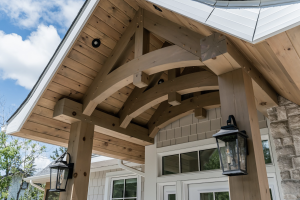
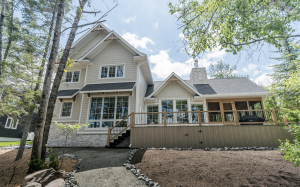
The exterior of the South Shore home introduces a covered timber entry and gable assemblies featuring curving tie beams. While visually distinct from the modern interior, these components remain structurally integral.
The covered entry performs multiple engineering roles:
-
Protection of door assemblies from precipitation
-
Reduction of wind-driven rain at primary opening
-
Redistribution of snow shedding from roof planes
Tie beams within gable assemblies resist outward thrust generated by roof rafters. Curved geometry modifies force vectors but does not alter fundamental load path requirements. Compression and tension forces are resolved through properly sized members and reinforced joinery.
Exterior timber is exposed to cyclic wetting and drying, freeze-thaw conditions, and UV radiation. Durability strategy includes:
-
Elevated clearance from grade
-
End grain sealing
-
Corrosion-resistant connectors
-
Drainage detailing at horizontal interfaces
Proper flashing at beam-to-wall transitions prevents moisture intrusion into the building envelope.
Structural Integrity and Load Path Continuity
The South Shore project maintains consistent load paths from roof diaphragm through trusses, into primary posts, and down to foundation. Whether expressed in modern interior volumes or rustic exterior detailing, the timber elements are not decorative overlays. They are active structural participants.
Key performance considerations include:
-
Snow load distribution across scissor trusses
-
Lateral stability under wind exposure
-
Control of creep deformation in heavy timber
-
Moisture management within the envelope
The integration of modern design language with traditional timber framing does not compromise structural performance. Instead, it demonstrates how engineered heavy timber systems can adapt to varied architectural expressions while preserving mechanical logic and durability.
The result is a lake home where structural engineering, material science, and architectural intent operate as a unified system rather than competing aesthetics.