The Benefits of Timber Frame
You are likely here because something about timber frame construction has caught your attention. If you’re drawn to timber, those reasons usually grow over time. Timber frames bring together structure, craft and comfort in a way that few building systems can match.
Below we highlight some of the key ways that building with big wood can positively impact daily life – visually, emotionally, environmentally and financially.
Visually Engaging
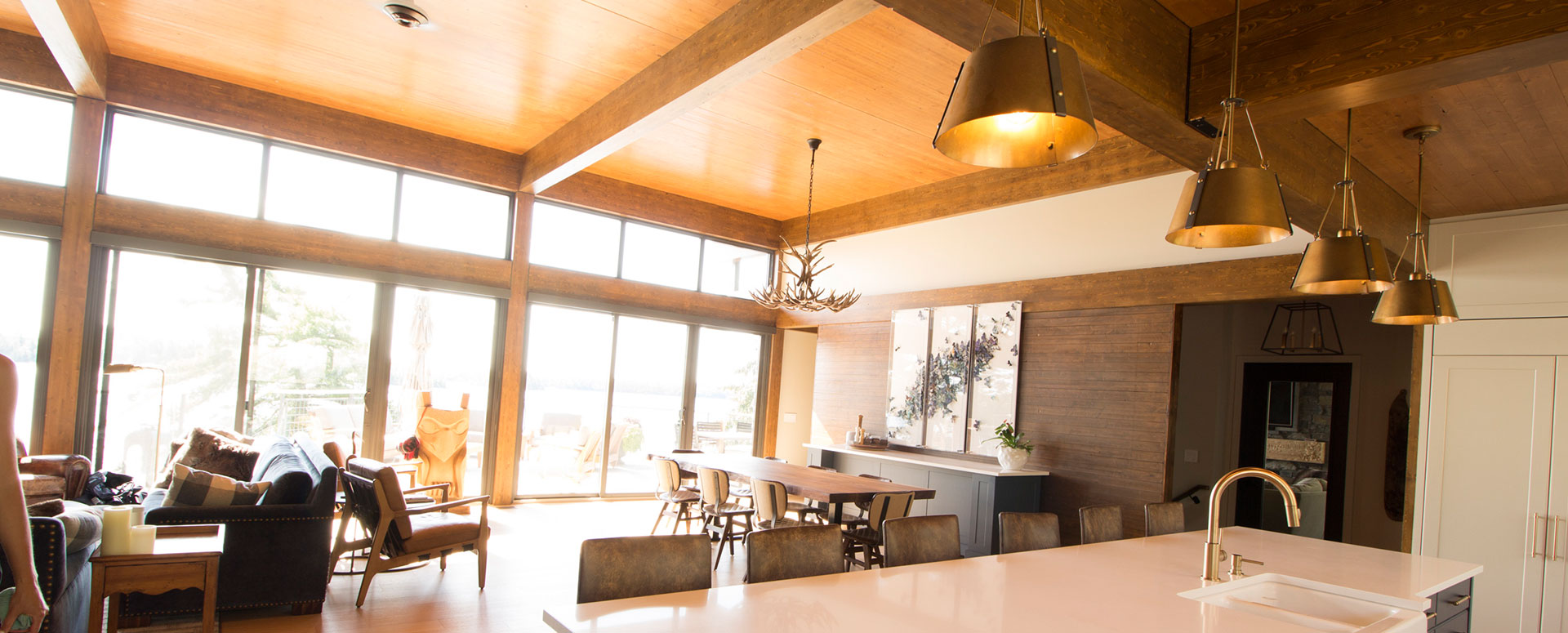
A common report from our clients is that they love the look of timber and feel happy every time they step into their timber frame home or cottage.
The presence of timber engages our appreciation of beauty: “Our timber frame living room feels like a big piece of art,” one owner commented, “we love how each time we look at it, we see it in a new way.”
And like good art, timber framed spaces activate both the eye and the mind. Another client noted: “In the old place, we used to have the TV on all the time. Now, it’s way less. Our timber frame – it’s so interesting, I keep looking up and marvelling at how it all joins together.”
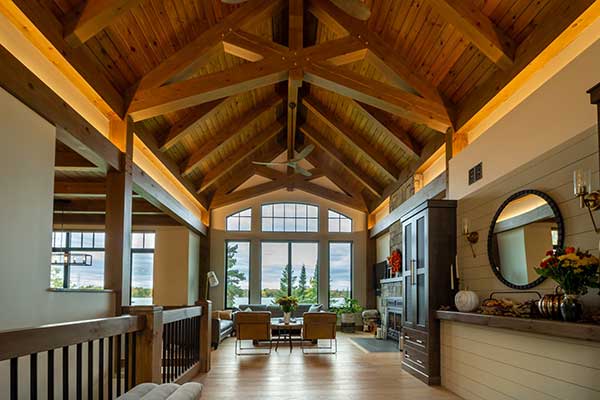
Timber frames: spaces to unwind in and be refreshed.
Biophilic — Our Response to Nature
In every decade since 1970 we’re spending less and less time outdoors. Today, the average Canadian spends around 94% of their life in buildings or cars and just 6% outdoors.
Nature is calling us: rolling farmland along the Elroy–Sparta State Trail, Wisconsin.
A growing body of research shows that our indoor spaces affect our health. People in environments with little or no natural material tend to experience higher stress, more sick days, higher blood pressure and lower productivity.
In contrast, interiors with more wood, plants and other natural elements are associated with feelings of wellbeing, higher energy, creativity and lower stress levels.
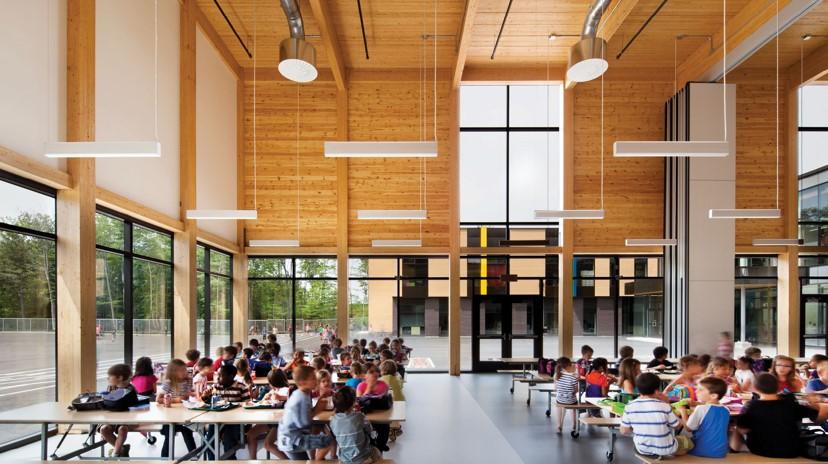
The use of wood in a school cafeteria – warm, calming, welcoming.
Energy Efficient
Timber frames carry all the roof loads of a building, freeing the walls and roof assemblies to be fully dedicated to insulation. By contrast, conventionally built homes use 2×6 studs every 16", and taken together these represent roughly 10–12% of the total wall area – a significant source of thermal bridging.
Worse, insulation must be fitted around studs, introducing hundreds of small gaps where the insulation cannot fully close the space between members.
A timber frame structure combined with insulated wall and roof panels can be over 30% more energy efficient than the same home built with 2×6 lumber.
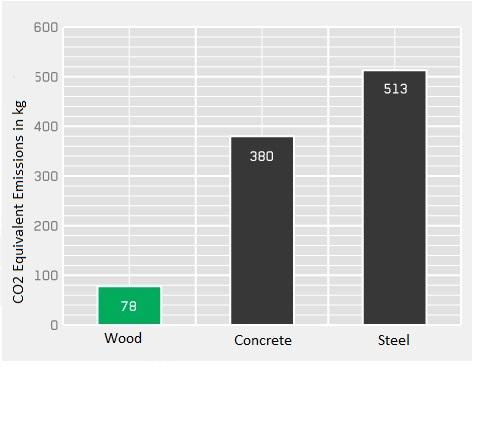
This chart shows how many kilograms of CO2 are generated to create a beam 7.3 m (24 ft) long, supporting 14.4 kN/m (1,060 lbs/ft), in three materials. Numbers do not include CO2 sequestered in materials.
Sustainable
Our use of the earth’s natural resources is at a critical point. Timber frames, when sourced from responsibly managed forests, play a meaningful role in building a more sustainable future.
Properly managed forests are a renewable resource whose trees can store carbon for decades and even centuries. When that wood fibre is used in long-lived structures like timber frames, the carbon is kept out of the atmosphere for as long as the building stands – potentially centuries more. When a building is deconstructed, the timbers can be re-used in products ranging from flooring to furniture.
Cornerstone Timberframes is committed to responsible forestry that maintains the capacity of the forest and all species that depend on it. We partner with suppliers who share this commitment.
One cubic metre of wood stores roughly 765 kilograms of CO2. Through trees, nature provides one of the most effective programs we have to limit climate change.
Structurally Superior
When you build a timber frame, you’ll enjoy beauty and the amazing strength properties of big wood. Combined with structural panels, timber frames can safely resist wind forces capable of removing roofs from conventionally framed buildings.
Timber frames also perform well in fires due to the large cross sections of the members. During a fire, a char layer forms on the outside of the timber, insulating its core and load-carrying capacity and buying valuable time for fire crews to do their work.
In seismically active regions, timber’s ability to flex and move without breaking gives it a long track record of remaining standing when materials like concrete and brick crack and fall.
Versatile
Timber framing is a powerful design ally for achieving the aesthetic look you’re after. Rustic, contemporary, ornate, minimalist, industrial and refined looks are all possible. With hybrid techniques and custom steel connections, even more design latitude is available. Tell us the look you want to achieve — our design team is here to help you dream.
Cost / Reward
Timber framing also delivers financial benefits. In real estate, the added cost of timber is weighed against its impact on market demand and eventual re-sale values. Commercial projects offer a useful indication of both.
Commercial developers are highly focused on returns, and their rapid acceptance of timber tells us a lot about the payoffs they are seeing.
In 2022, lessors were obtaining an average premium of US $7.00 per square foot for buildings constructed with big timber1. In 2018, one of Minneapolis’s first mass timber buildings, the 7-storey T3 building, sold for approximately US $382 per sq. ft., nearly double the typical rate for commercial space in the Twin Cities2.
Well designed timber frame structures, residential and commercial alike, appeal to a wide range of clients seeking the ambience of wood. They consistently achieve higher-than-market returns when offered for sale.
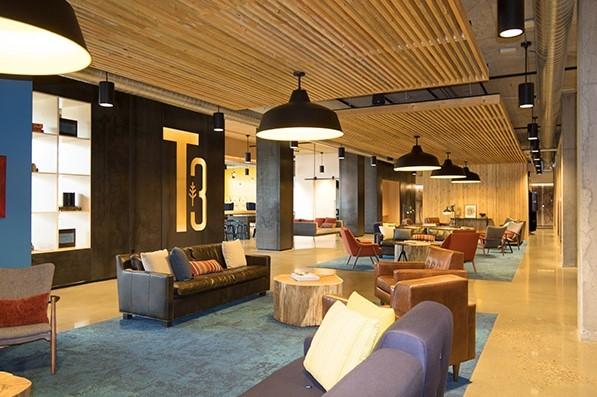
T3 Building, North Loop, Minneapolis – timber is in demand for new office space.