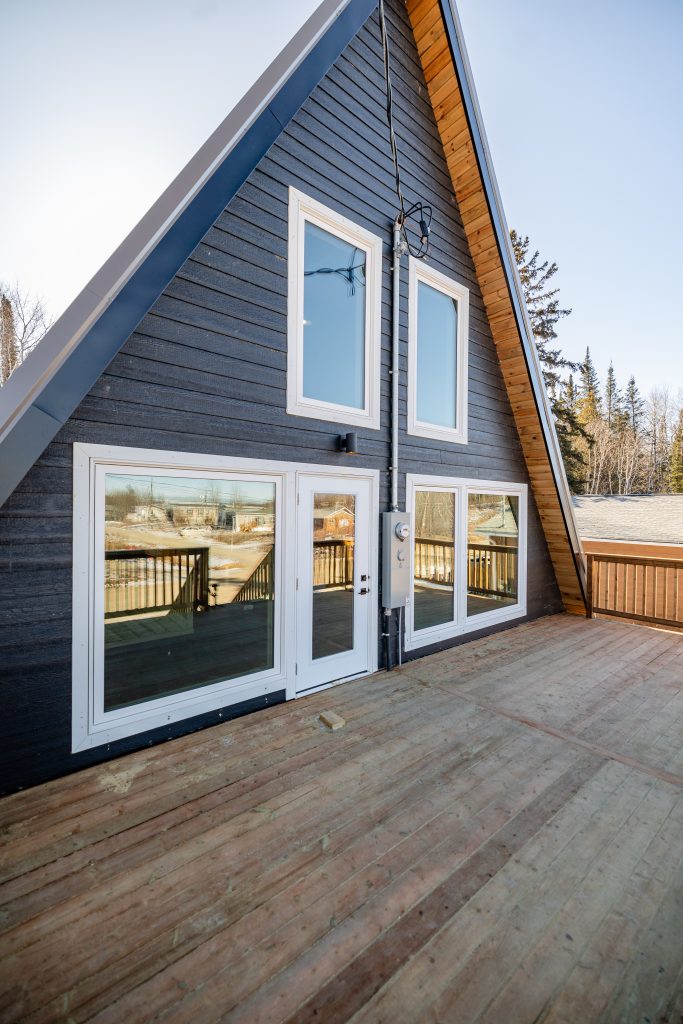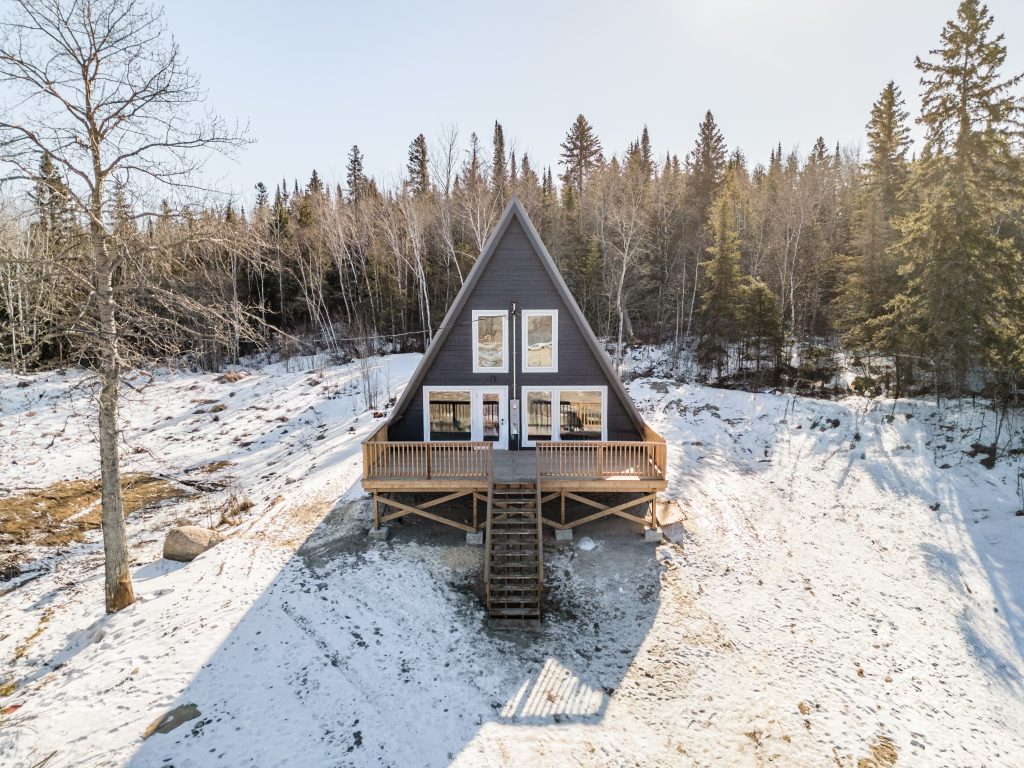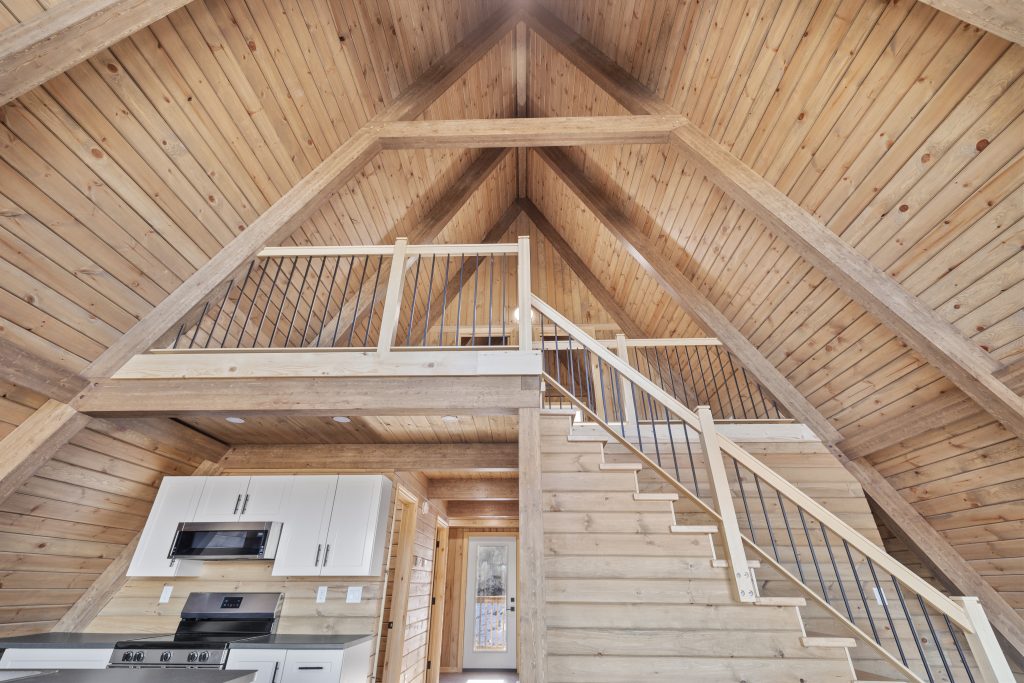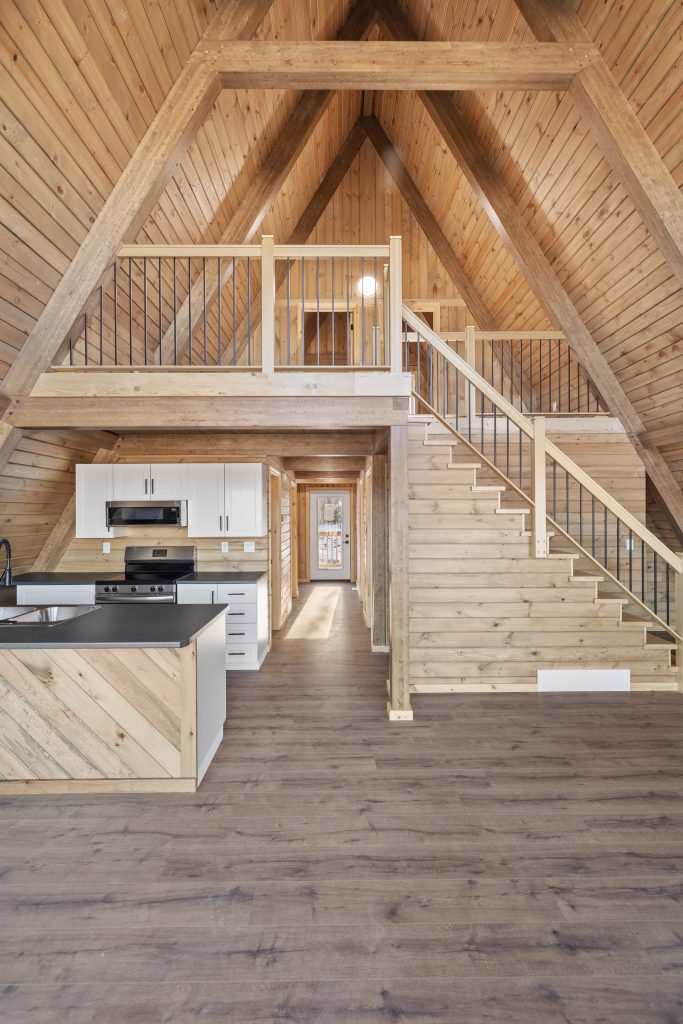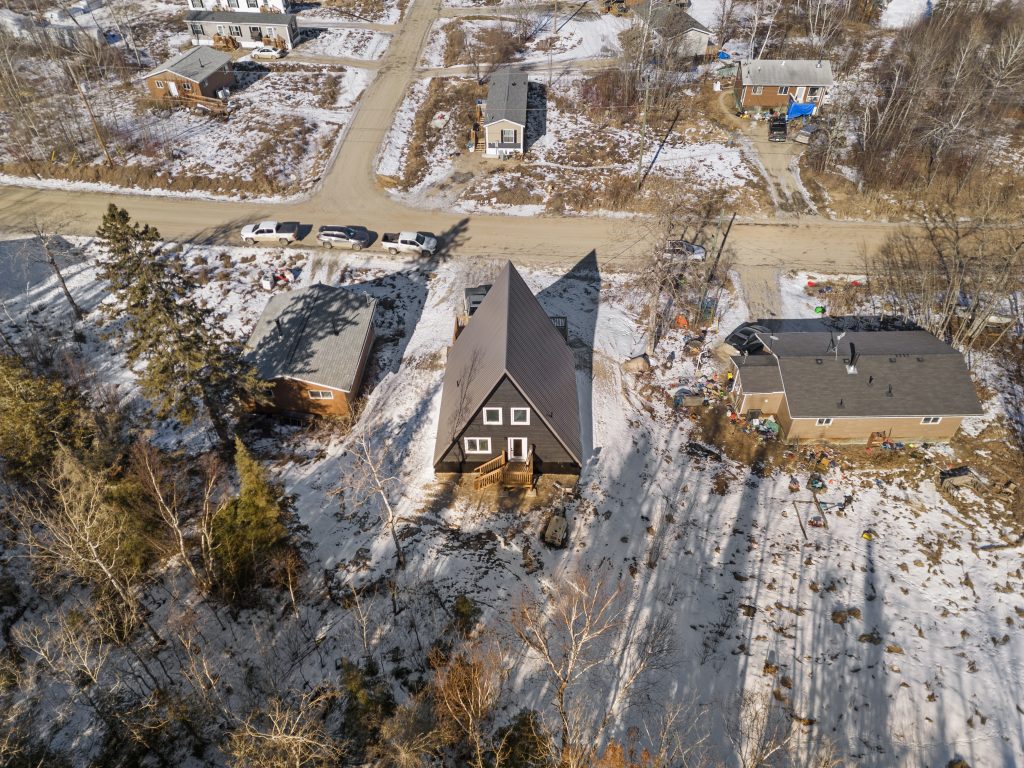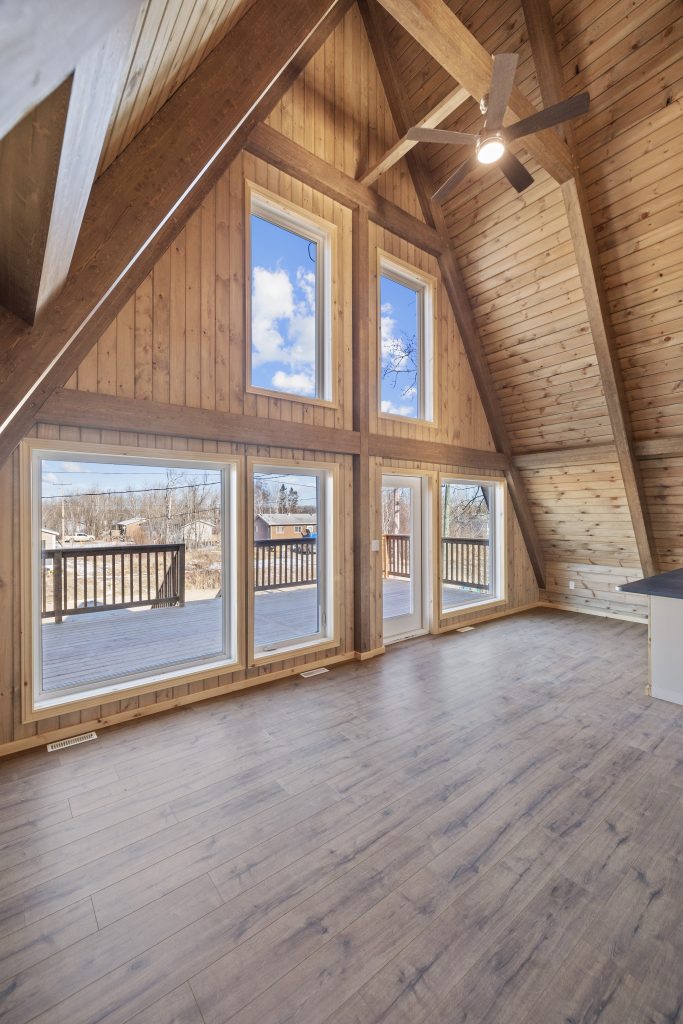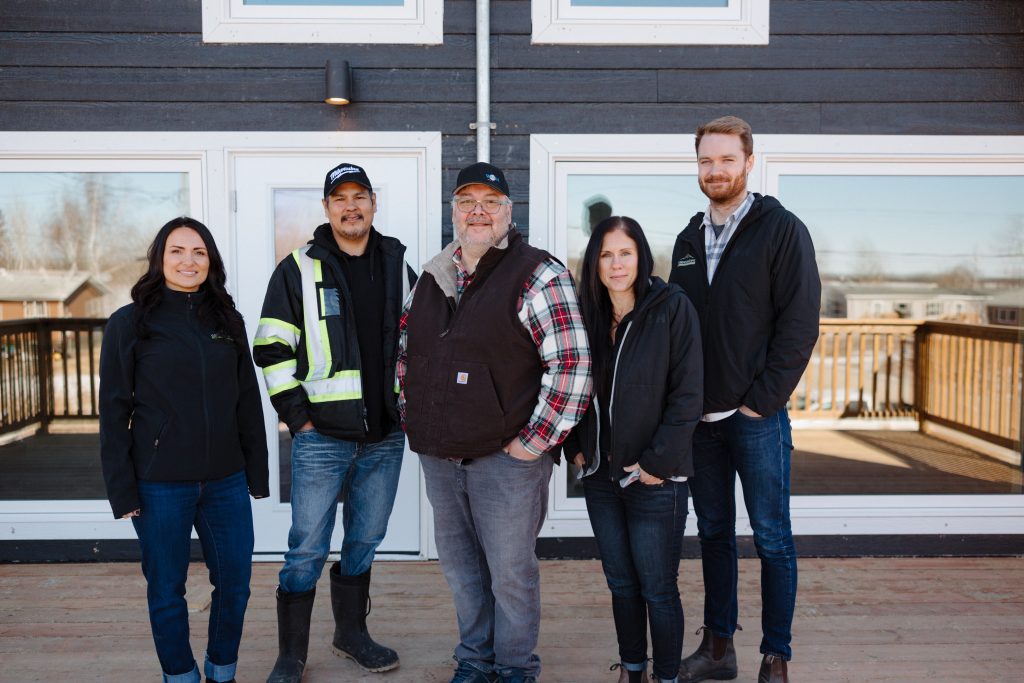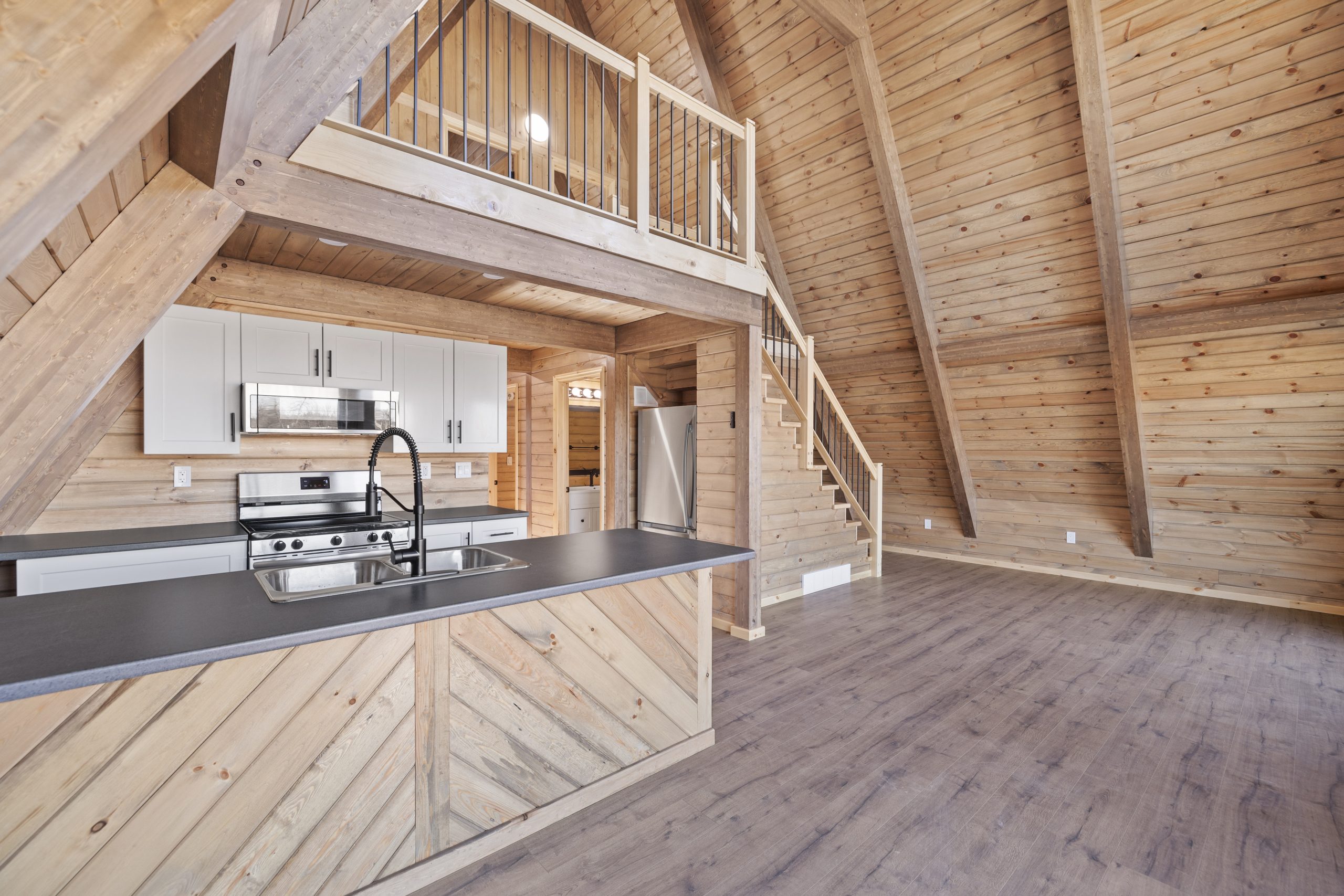
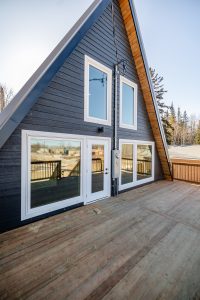
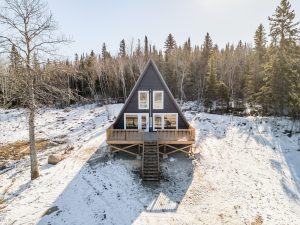
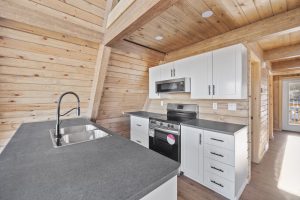
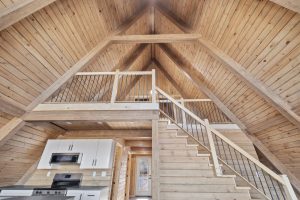
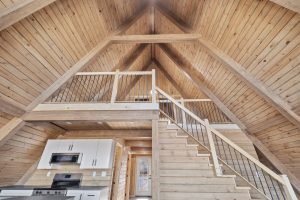
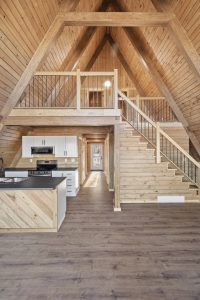
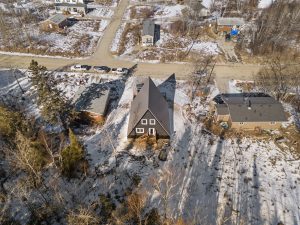

The Freedom Road A-Frame project in Northwestern Ontario was developed in collaboration with a First Nation community that defined clear priorities: durable housing, natural materials, high energy performance, and construction methods suitable for remote delivery.
In northern Indigenous communities, housing is not simply infrastructure. It is foundational to health, safety, intergenerational stability, and cultural continuity. The structural system, material palette, and construction methodology were selected to support long-term durability under cold-climate conditions while reinforcing emotional comfort through visible natural materials.
This project demonstrates how mass timber residential design can integrate structural engineering, building science, and community-driven values within a scalable housing framework.
A-Frame Geometry: Structural Efficiency in Cold Climates
The A-Frame is one of the oldest structural typologies in human history. Its triangular geometry creates inherent stability through direct load transfer along inclined members.
From an engineering perspective, the A-Frame form provides:
-
Efficient snow shedding due to steep roof pitch
-
Reduced wind uplift through aerodynamic profile
-
Direct axial load paths from ridge to foundation
-
Minimal exterior wall area relative to enclosed volume
In northern Ontario, snow load accumulation and freeze-thaw cycling are primary environmental forces. The steep roof angle reduces snow drift retention and limits prolonged compressive loading on roof assemblies.
Because the roof plane doubles as exterior wall, structural continuity is simplified. Loads travel along glulam rafters directly to foundation supports without complex intermediate framing.
Prefabricated Mass Timber System and Standardization
Cornerstone produces the Freedom Road A-Frame as a prefabricated kit of parts available in four standardized sizes. Standardization enables predictable structural performance and construction efficiency.
Benefits of the prefabricated system include:
-
Controlled factory fabrication tolerances
-
Reduced site labor duration
-
Minimized weather exposure during assembly
-
Repeatable quality across multiple units
Remote construction logistics often limit staging space and skilled labor availability. Prefabricated mass timber components reduce on-site cutting, improve dimensional accuracy, and shorten erection time.
Structural members are delivered pre-engineered for regional snow and wind loads. Continuous load paths are preserved through precisely fabricated connections.
Mass Timber Structural Core: Nordic Glulam Frame
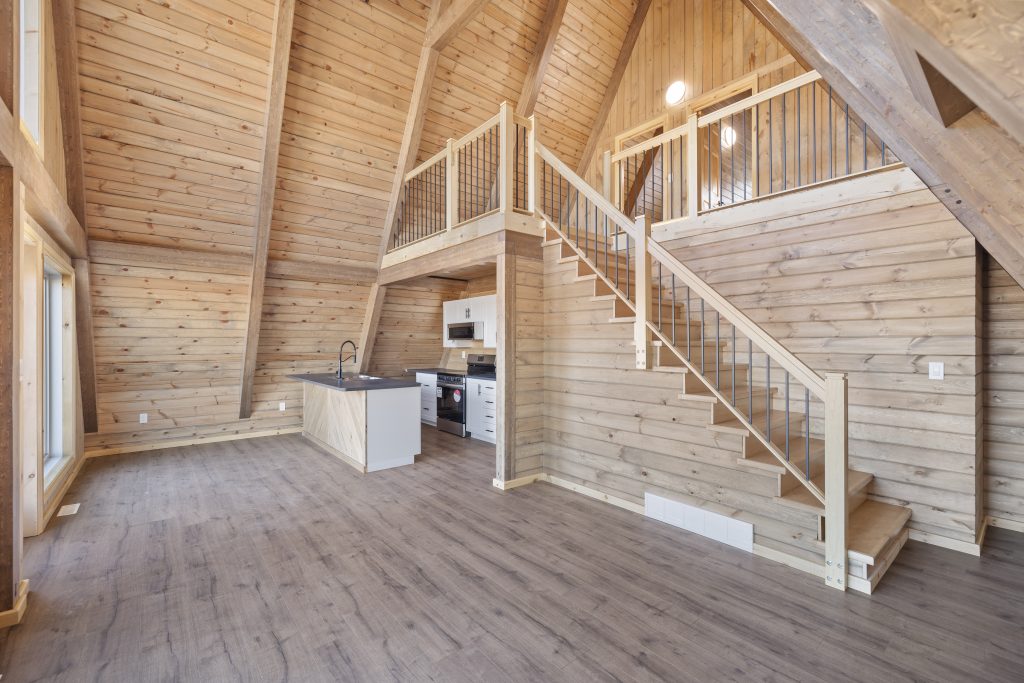
The primary load-bearing system consists of Nordic glulam timbers forming the inclined A-Frame structure.
Glulam provides:
-
High compressive strength parallel to grain
-
Predictable modulus of elasticity
-
Reduced variability compared to solid sawn lumber
-
Long-span capability with controlled deflection
Axial compression forces travel along the inclined rafters into foundation anchorage. Horizontal thrust is resisted through structural floor diaphragms and tie connections at base levels.
Creep deformation under sustained snow load is evaluated during design. Member sizing incorporates long-term deflection limits to maintain serviceability.
Because glulam members are dimensionally stable under controlled moisture content, joint integrity is preserved over seasonal humidity variation.
Roof and Ceiling Assembly: Dual-Purpose T&G Deck
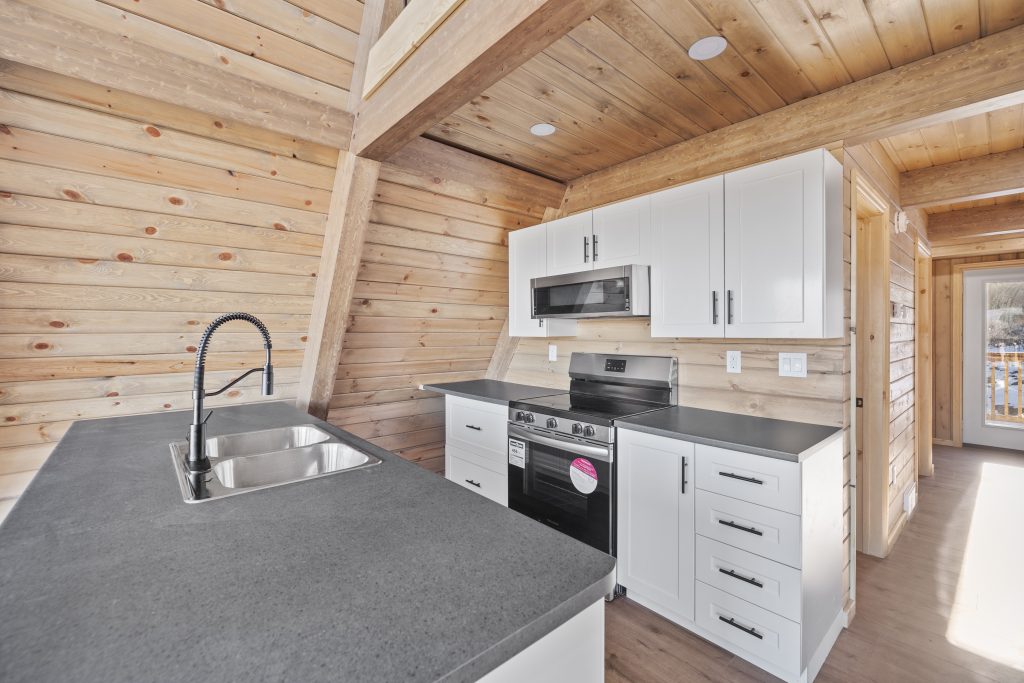
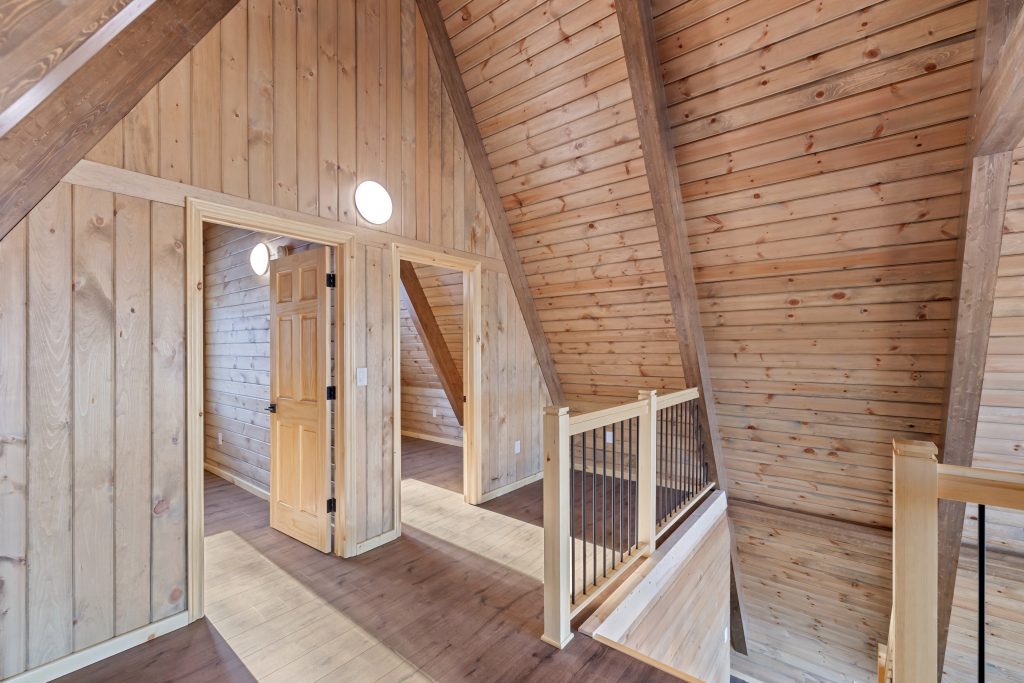
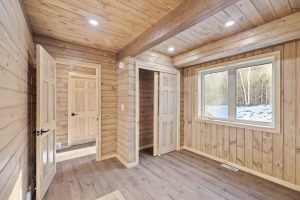
The roof and ceiling assembly uses 2×6 tongue-and-groove pine boards that serve two structural roles:
-
Interior ceiling finish
-
Structural roof deck
This dual-function assembly reduces material redundancy. The continuous T&G deck ties the frame together, providing diaphragm action and distributing lateral forces.
The solid wood deck creates a continuous nail base for high-performance insulation layers. This supports:
-
Airtight detailing
-
Continuous thermal insulation
-
Reduced thermal bridging
Airtightness is critical in northern climates where uncontrolled air leakage significantly increases heat loss and condensation risk.
Energy Efficiency and Building Envelope Performance
Energy efficiency was central to the project’s objectives. The A-Frame geometry inherently reduces heat loss by minimizing exposed wall area relative to interior volume.
Envelope performance strategies include:
-
Continuous exterior insulation
-
High-performance vapor control layers
-
Airtight joint sealing at structural connections
-
Ventilated roof assembly to prevent condensation
Mass timber provides moderate thermal inertia. While lighter than concrete, wood moderates short-term temperature fluctuation when combined with controlled ventilation systems.
Reduced exterior surface complexity decreases opportunities for thermal bridging and air infiltration.
Long-term durability directly influences operating cost stability for homeowners and the community.
Daylighting and Interior Wellbeing
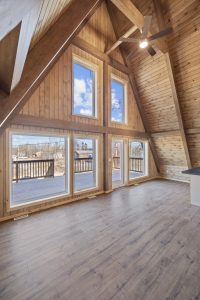
The A-Frame form creates soaring interior volumes despite compact footprints. Abundant natural light reduces reliance on artificial lighting and improves occupant wellbeing.
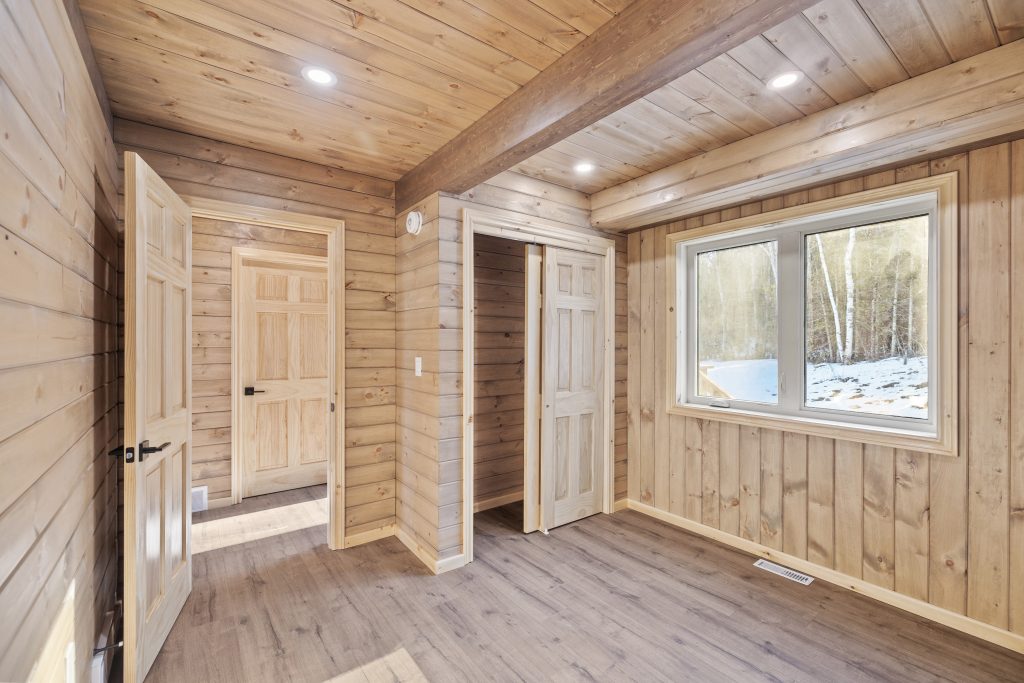
Visible wood surfaces contribute to:
-
Psychological comfort
-
Acoustic dampening
-
Perceived warmth
For communities affected by historical housing instability, spatial clarity and material honesty support dignity and safety.
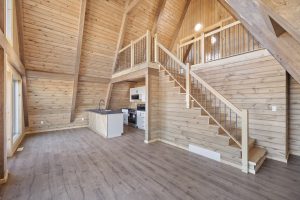
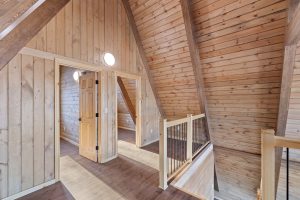
Interior layout emphasizes clear circulation paths and functional zoning without unnecessary structural partitions. The open plan maintains structural efficiency while enhancing livability.
Durability in Remote Northern Environments
Northwestern Ontario presents environmental challenges including:
-
Extended sub-zero temperatures
-
Snow load accumulation
-
Freeze-thaw cycling
-
Elevated seasonal humidity
The Freedom Road A-Frame addresses these through:
-
Steep roof pitch for snow shedding
-
Continuous load paths from ridge to foundation
-
Moisture-protected connections
-
Corrosion-resistant fasteners
Foundation systems are designed to resist frost heave and soil movement. Proper drainage and capillary breaks prevent moisture intrusion at structural base interfaces.
Long-term maintenance simplicity was prioritized. Exposed timber is accessible for inspection, and structural logic remains visible and understandable.
Prefabrication and Housing Equity
Prefabricated mass timber construction supports housing equity by improving delivery reliability.
Advantages include:
-
Shortened on-site construction timelines
-
Reduced exposure to weather-related delays
-
Budget predictability
-
Consistent structural quality across units
In remote Indigenous communities, reduced construction duration translates directly into more homes delivered efficiently.
Controlled fabrication environments also improve workmanship precision compared to extended site-built processes.
Timber as Structural and Cultural Alignment
Mass timber is both structural system and material statement. Wood aligns with principles of stewardship and connection to land.
Environmental benefits include:
-
Carbon storage within structural members
-
Reduced embodied emissions relative to concrete or steel
-
Renewable resource sourcing
Timber ages predictably and can be maintained with straightforward repair strategies. Visible structure reinforces transparency and structural honesty.
Long-Term Performance and Community Stability
The Freedom Road A-Frame project illustrates how mass timber residential construction can address technical, environmental, and social objectives simultaneously.
The system delivers:
-
Structural efficiency under northern snow and wind load
-
High energy performance
-
Prefabrication advantages for remote construction
-
Interior environments that promote comfort and wellbeing
These homes are engineered for durability and long service life. They are not temporary solutions but long-term investments in community resilience.
Mass timber here is precise, efficient, and aligned with both environmental physics and human needs.