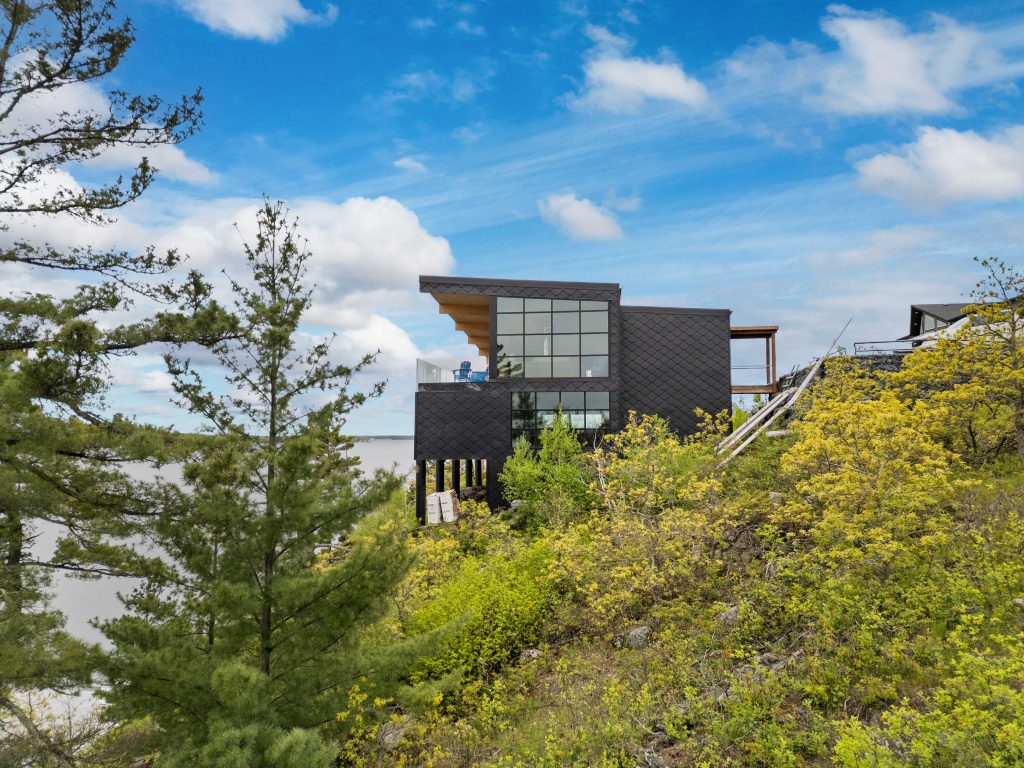

Falcon 54 is positioned on a high bluff overlooking Falcon Lake in eastern Manitoba. The site geometry introduces slope-induced load concentration, wind exposure amplification and limited construction access. The residence was engineered as a mass timber system where structural performance governs architectural expression.
On elevated lakefront terrain, wind velocity increases due to reduced surface friction across open water. Roof uplift forces and lateral shear must therefore be resolved through continuous load paths extending from roof diaphragm to foundation anchorage. At Falcon 54, the structural system follows the view orientation, not vice versa. Sightlines are preserved through open spans while structural stability is maintained through panelized mass timber assemblies.
The project was developed through coordinated collaboration between the client and Cornerstone Timberframes. Structural grid, envelope systems and architectural intent were resolved simultaneously, not sequentially.
Mass Timber Structural System: CLT and Glulam Integration
Falcon 54 utilizes prefabricated cross laminated timber panels and glulam beams as primary structural components. CLT panels act as both vertical load-bearing walls and horizontal diaphragms. Glulam beams manage long-span bending and concentrated deck loads.
Mass timber performance characteristics include:
-
High compressive strength parallel to grain
-
Predictable modulus of elasticity for span calculation
-
Dimensional stability under controlled moisture content
-
Fire performance through char layer protection
CLT panels provide two-way load distribution, reducing point stress concentration. Glulam members support cantilevered deck projections and extended overhangs without excessive deflection.
Creep deformation under sustained load was evaluated during engineering. Long-term deflection limits were incorporated into member sizing to maintain serviceability over time.
This is structural timber used as a primary load-bearing system, not decorative cladding.
Large Cantilevered Decks and Overhang Engineering
The residence features cantilevered decks projecting over the bluff terrain. Cantilever design introduces negative bending moments at support points and uplift sensitivity at deck edges.
Engineering controls include:
-
Reinforced glulam beams with adequate section modulus
-
Steel knife plates or concealed connectors rated for tension
-
Continuous vertical load path transfer to foundation
Extended roof overhangs are resolved through cantilever action and braced support geometry. Snow load and wind suction were calculated using regional climatic data. Uplift resistance is anchored through tension-rated connectors embedded into structural walls and foundation elements.
Deck assemblies incorporate drainage slope and moisture protection detailing to prevent hydrostatic pressure buildup during freeze-thaw cycles.
Open Interior Volumes and Structural Clarity
Falcon 54 achieves uninterrupted sightlines through open interior volumes. This is made possible by CLT floor and roof panels spanning between glulam supports.
Structural implications include:
-
Reduction of intermediate bearing walls
-
Increased diaphragm stiffness
-
Controlled vibration performance under occupancy load
Mass timber panels provide inherent diaphragm action, enhancing lateral stability. Load paths remain visible and legible within the architectural expression, reinforcing structural honesty.
Interior climate control is coordinated with timber moisture management. Stable indoor humidity reduces dimensional movement and preserves connection integrity.
Construction Logistics on a Constrained Bluff Site
Site access limitations restricted assembly work strictly to the building footprint. Traditional stick framing would have required staging area expansion and extended construction duration.
Mass timber fabrication solved logistical constraints through:
-
Off-site precision manufacturing
-
Just-in-time delivery sequencing
-
Rapid installation with crane placement
Prefabricated CLT panels and glulam beams arrived dimensionally accurate, reducing on-site cutting and minimizing disturbance to the landscape.
This approach parallels methodologies used in mass timber commercial projects, where schedule efficiency and dimensional precision are critical.
Envelope Integration and Reynaers Window Wall System
High dimensional accuracy of mass timber fabrication enabled seamless integration of the Reynaers aluminum window wall system.
Performance benefits include:
-
Tight tolerances at structural openings
-
Reduced air leakage potential
-
Improved thermal continuity
Precision in CLT panel fabrication allows exact window rough opening dimensions. This minimizes shimming and field modification, preserving envelope performance.
Thermal bridging is controlled through coordinated insulation detailing at panel edges. Air barrier continuity is maintained across panel joints using sealed membranes and engineered connection interfaces.
The integration between structure and glazing system reflects coordinated BIM-level planning and tolerance control.
Environmental Performance and Sustainability
Mass timber construction contributes to reduced environmental impact through:
-
Carbon sequestration in structural members
-
Reduced embodied energy compared to steel or concrete
-
Efficient prefabrication minimizing site waste
Energy-efficient performance is supported by:
-
Continuous insulation strategies
-
High-performance glazing
-
Airtight CLT panel assemblies
Thermal mass characteristics of CLT moderate interior temperature fluctuations. While lighter than concrete, mass timber still provides meaningful heat storage capacity when integrated with controlled ventilation systems.
Durability considerations include moisture management, UV protection at exposed edges and proper flashing at all structural penetrations.
Structural Philosophy: Residential and Commercial Parity
Falcon 54 demonstrates that mass timber residential architecture can apply the same engineering rigor used in commercial projects.
Core principles include:
-
Defined load paths
-
Prefabrication accuracy
-
Structural redundancy
-
Envelope coordination
The system is not experimental. Mass timber assemblies have been validated across institutional and commercial applications. In residential scale, the same structural logic provides architectural freedom without compromising reliability.
Conclusion: Mass Timber Built with Intent
Falcon 54 is engineered to belong to its site. Elevated on a bluff, exposed to wind and seasonal climate variation, it relies on structural clarity rather than concealment.
Large cantilevered decks, extended overhangs, open volumes and precise glazing integration are made possible by mass timber performance, not decorative surface treatment.
The project demonstrates how CLT and glulam systems deliver structural integrity, construction efficiency and environmental responsibility in a high-performance lakefront residence.
Mass timber here is structural, measurable and enduring.