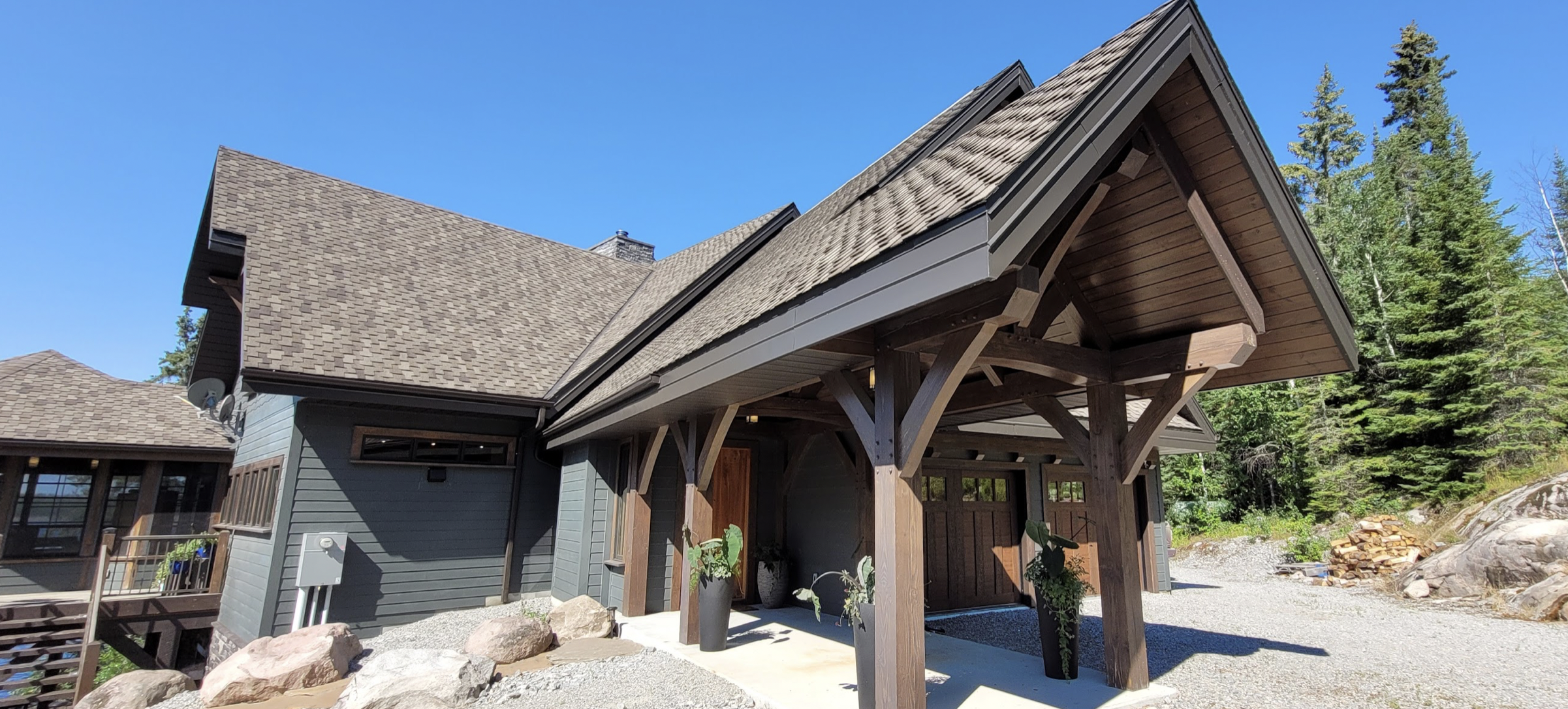


The Deep Waters project represents a heavy timber lakefront cottage engineered for exposed granite terrain, high wind exposure, complex roof geometry, and amplified solar reflection from open water. The structure is not defined by aesthetics alone. Its performance is governed by structural integrity, continuous load paths, thermal physics, and durability under cyclic environmental stress.
The building envelope, roof framing system, and foundation anchorage were designed as an integrated structural organism. Each visible timber component carries load, manages deformation, or mitigates environmental impact.
Granite Bedrock Interface and Foundation Strategy
The cottage is founded directly on exposed granite bedrock that slopes sharply toward the lake and continues underwater to depths exceeding 150 ft. Unlike soil-bearing systems, granite substrates eliminate consolidation settlement but require engineered anchorage.
Core-drilled anchor pockets are installed into bedrock, followed by epoxy-set threaded anchor rods rated for pull-out resistance and freeze-thaw durability. Adhesive selection accounts for damp substrate bonding and long-term creep resistance under sustained uplift forces.
Reinforced concrete piers are pinned into granite using doweled rebar connections to establish shear transfer continuity. Edge distance and embedment depth are calculated to prevent localized rock splitting and to maintain compressive stress distribution within allowable limits.
Because the structure is located on an exposed waterfront, wind velocity is amplified by unobstructed fetch across the lake. Uplift forces on the roof diaphragm are transmitted through rafters, into primary beams, down posts, and finally into granite anchors. This uninterrupted vertical load path ensures structural coherence during peak wind events.
Granite mass also contributes to stability against hydrostatic fluctuation during seasonal water level change.
Cross-Gabled Roof Geometry and Load Paths
The cross-gabled configuration creates intersecting roof planes that converge at valley rafters. In cold-climate regions, valley zones accumulate snow drift loads that exceed uniform roof loading assumptions.
Structural mitigation includes:
-
Oversized valley rafters with reduced slenderness ratio
-
Parallel chord timber trusses providing mid-span reaction
-
Load redistribution into primary posts
These measures reduce bending stress and limit long-term creep deformation in heavy timber members.
The roof assembly incorporates a ventilated cold roof strategy. Continuous soffit-to-ridge airflow removes moisture vapor and reduces condensation risk within the insulation layer. Ice and water membranes are installed at valley transitions, and flashing integration is coordinated at all beam penetrations through the building envelope.
Air sealing around timber elements prevents convective heat loss and moisture migration.
West-Facing Overhangs and Passive Solar Control
The lake-facing elevation is oriented westward. Solar reflection from water surfaces increases glazing heat load during afternoon exposure.
Large overhang projections are engineered using solar geometry calculations. Projection depth is calibrated relative to glazing height and summer solar angle. This ensures:
-
Reduction of peak cooling load
-
Controlled winter solar penetration
-
Decreased UV degradation of interior finishes
These overhangs function as passive solar control devices while protecting glazing assemblies from direct precipitation.
From a structural standpoint, extended roof projections generate cantilever bending moments. Brace-supported outlook beams create triangular load transfer geometry that converts bending into axial compression along braces. Timber sizing accounts for modulus of elasticity and creep coefficients under sustained snow load and dead load.
Wind uplift suction is countered through concealed steel connectors and tension-rated anchor rods integrated into the continuous load path.
Great Room Structural Core and Thermal Mass
The great room incorporates a soapstone fireplace with an exposed 20 ft flue pipe extending through the vertical volume of the space.
Soapstone provides high specific heat capacity, enabling thermal mass behavior. Heat absorbed during active combustion is released gradually, reducing temperature fluctuation and mechanical heating demand.
From an engineering standpoint, the fireplace introduces concentrated vertical load. The hearth foundation is reinforced to distribute compressive forces into the granite-anchored substructure. The flue system requires intermediate bracing to limit lateral oscillation and thermal expansion allowances to prevent stress cracking.
Stack effect generated by the 20 ft flue height enhances draft efficiency, supporting combustion performance and indoor air quality.
Parallel Chord Timber Trusses and Mid-Span Support
Parallel chord timber trusses are integrated into the great room volume. Their function extends beyond architectural expression.
These trusses:
-
Provide mid-span support to long valley rafters
-
Reduce deflection under snow load
-
Improve structural redundancy
-
Stabilize roof diaphragm geometry
By distributing tensile and compressive forces across interconnected members, the truss assembly controls deformation and enhances dimensional stability over time.
Creep deformation in heavy timber is considered in sizing and connection detailing to maintain long-term serviceability limits.
Entry Canopy, Brackets, and Screen Room Integration
The entry canopy is structurally integrated into the primary timber grid. Timber brackets are engineered to transfer shear and bending forces into vertical posts.
Connection detailing incorporates:
-
Concealed steel knife plates or traditional mortise and tenon joinery
-
Corrosion-resistant fasteners
-
Flashing at beam-to-wall interfaces
Proper drainage design prevents moisture intrusion at structural penetrations.
The screen room extends the timber rhythm outward while maintaining structural alignment with the primary grid. In waterfront conditions, lateral wind exposure and moisture cycling are dominant durability factors.
Fasteners are specified for corrosion resistance, and deck interfaces incorporate controlled drainage planes to prevent long-term decay.
Environmental Durability and Long-Term Performance
The Deep Waters cottage demonstrates a coherent integration of structural mechanics and environmental physics.
Bedrock anchorage eliminates differential settlement risk. Continuous load paths resist wind uplift and lateral forces. Parallel chord trusses mitigate valley rafter deflection. Passive overhang geometry reduces solar heat gain. Soapstone thermal mass stabilizes interior climate. Ventilated roof assembly prevents condensation accumulation.
Design decisions account for creep deformation, freeze-thaw cycling, hydrostatic fluctuation, UV exposure, and sustained snow load.
The result is a heavy timber structure optimized for structural integrity, environmental resilience, and durability in a high-exposure granite shoreline environment.


