May 20, 2025
Fire Resilience of Mass Timber in Modern Construction
Mass timber can perform predictably in fire because large wood elements char on the outside while preserving structural capacity inside. Fire resilience in mass timber construction depends on proper member sizing, char-rate design, fire protection systems, and code-compliant detailing.
Explore the full
Mass Timber Construction Guide
to understand how fire performance fits into the broader design, fabrication, and assembly process for modern timber buildings.
Key Considerations
- Mass timber is combustible, but large-section timber burns in a predictable way.
- The outer char layer insulates the inner core and helps preserve load-bearing capacity.
- Fire performance depends on engineered design, member sizing, connection detailing, and active protection systems.
- Full-scale testing has shown that mass timber structures can remain stable under severe fire exposure.
- Sprinklers, alarms, compartmentation, and code-compliant design remain essential parts of fire-resilient construction.
Wood Burns, But Mass Timber Behaves Differently
Wood burns, but mass timber does not behave like light framing or ordinary dimensional lumber. Large glulam and CLT elements form a protective char layer that slows heat transfer and helps maintain structural performance during fire exposure.
At first glance, the word “resilience” may seem optimistic when discussing fire. However, extensive real-world testing across Europe, Canada, and Australia consistently shows that large-section mass timber elements retain their structural capacity during fire exposure. This performance is rooted in the predictable way wood reacts to heat.
Fire Testing and Real-World Evidence
Fire testing helps engineers understand how mass timber assemblies perform under controlled severe conditions. These tests are especially important for multi-storey buildings where structural stability, evacuation time, and fire containment are critical.
A clear example comes from a full-scale fire test conducted on June 10, 2022, at the Ottawa Fire and Explosives Testing Facility.
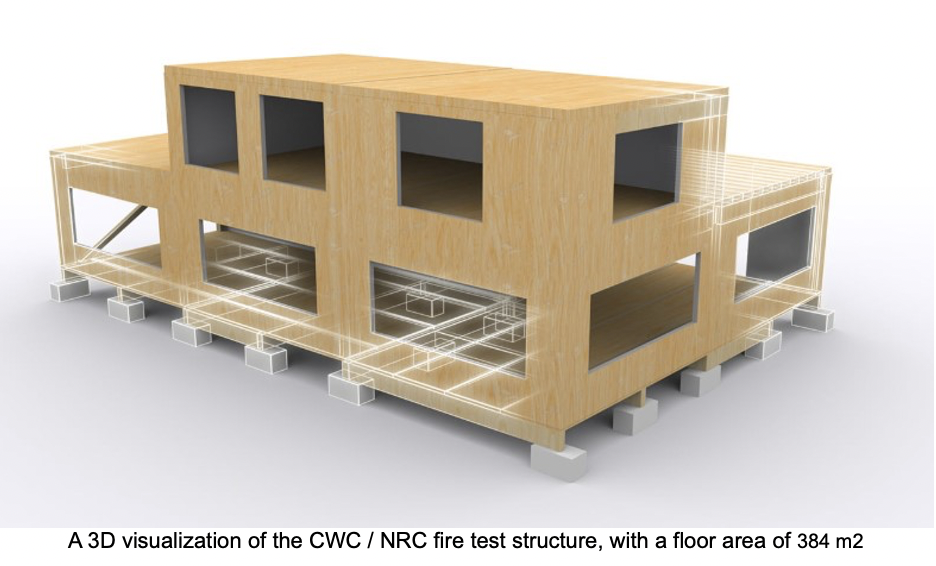
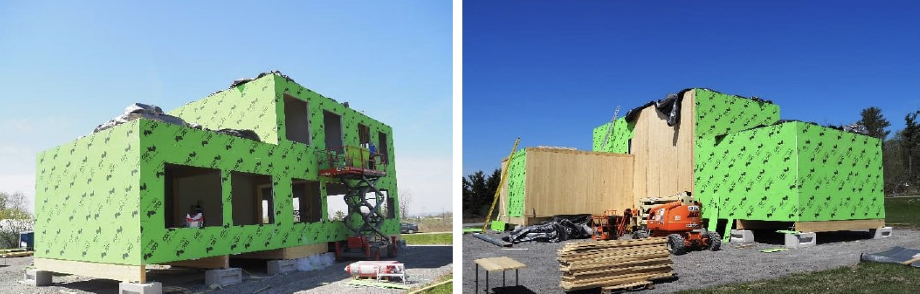
The Canadian Wood Council, supported by fire researchers from the National Research Council, tested a two-storey mass timber office building with an open floor plan. The final test was intentionally designed as a “worst-case scenario,” conducted without sprinkler activation or firefighter intervention.
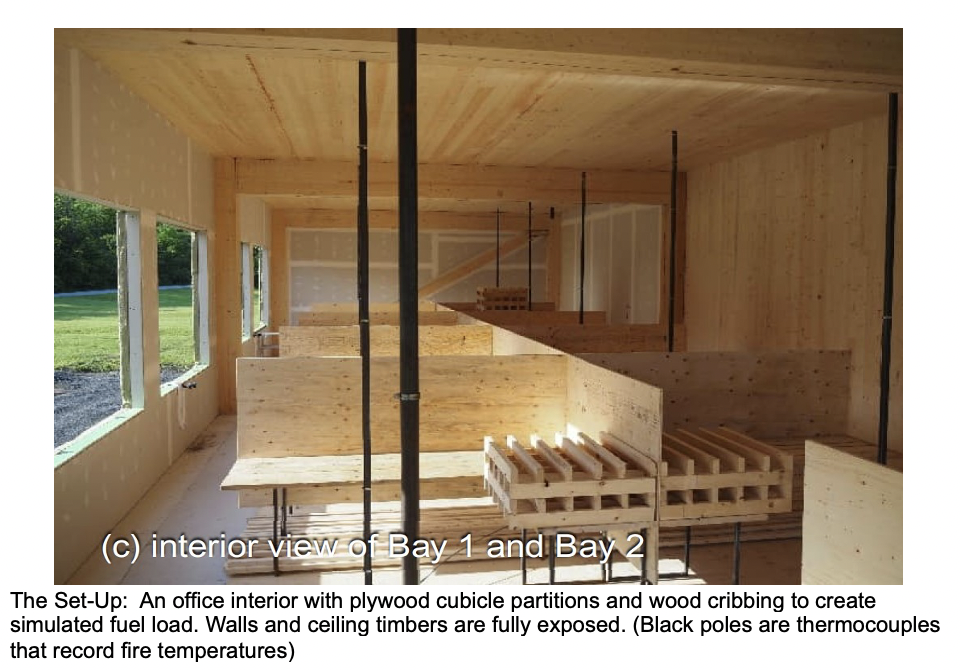
The interior was furnished with wood cribbing representing approximately 120% of a typical modern office fuel load. Doors and windows were left open to allow unrestricted air intake, and an aggressive ignition source was used to ensure rapid flame spread to the ceiling.

Ten minutes after ignition, the fire reached peak intensity before beginning a gradual decay.
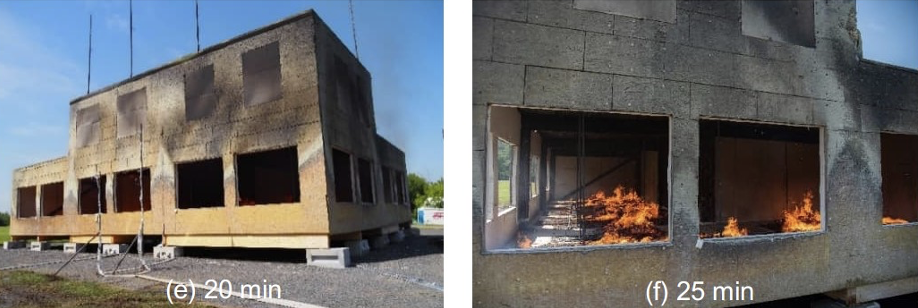
By 25 minutes, only residual contents continued to burn at low intensity. The fire ultimately lasted four hours and ten minutes and self-extinguished once the fuel load was exhausted. Despite the severity of the exposure, the structure remained stable and was safe to enter after the test.
Why Char Protects Mass Timber
The char layer is the main reason large-section timber can retain structural capacity during fire exposure. As the outer surface burns, it creates an insulating layer that slows the rate of heat penetration into the remaining wood section.
The building’s survival is explained by the predictable charring behavior of large timber members. When exposed to fire, timber forms a surface char layer that is both slow-burning and highly insulating. This char layer dramatically reduces heat transfer to the interior of the member, slowing the rate of material loss and preserving load-bearing capacity.
By accounting for char depth in design, mass timber elements can be sized to maintain structural integrity through severe fire exposure.
| Fire Design Factor | Why It Matters in Mass Timber |
|---|---|
| Char depth | Determines how much structural section remains after fire exposure. |
| Member size | Larger timber sections can retain a protected structural core longer. |
| Connection detailing | Steel plates, bolts, and bearing interfaces must be protected or designed for exposure. |
| Sprinkler systems | Reduce fire spread and help contain fire to the area of origin. |
| Compartmentation | Limits fire movement through the building and supports safer evacuation. |
The images above demonstrate that while fire presents a serious threat to life and property, mass timber behaves in a manner comparable to non-combustible systems. It is the contents that burn, while the structure retains its ability to carry loads. In multi-storey buildings, this behavior supports fire resilience scenarios where evacuation may be delayed and shelter-in-place becomes necessary.
Sprinklers and Active Fire Protection
Mass timber fire resilience is strongest when passive char-based performance is paired with active protection systems. Sprinklers, smoke detection, alarms, and code-compliant fire separations remain essential for life safety.
Modern building codes require automatic sprinkler systems in multi-unit residential buildings four storeys and higher, along with interconnected smoke detection and fire alarm systems. As a result, true worst-case fire scenarios are statistically rare.
Fire testing by engineering firm Arup in Europe demonstrated that low-pressure water mist systems effectively suppressed fires in mass timber buildings, limiting damage to minor surface discoloration of ceiling panels and resulting in minimal water damage.
Conclusion
Fire will always remain a risk, but modern mass timber design significantly improves life safety and structural resilience. While mass timber is difficult to ignite, its charring behavior protects load-bearing capacity when exposed to fire. When combined with active fire protection systems, fires are typically contained to the area of origin.