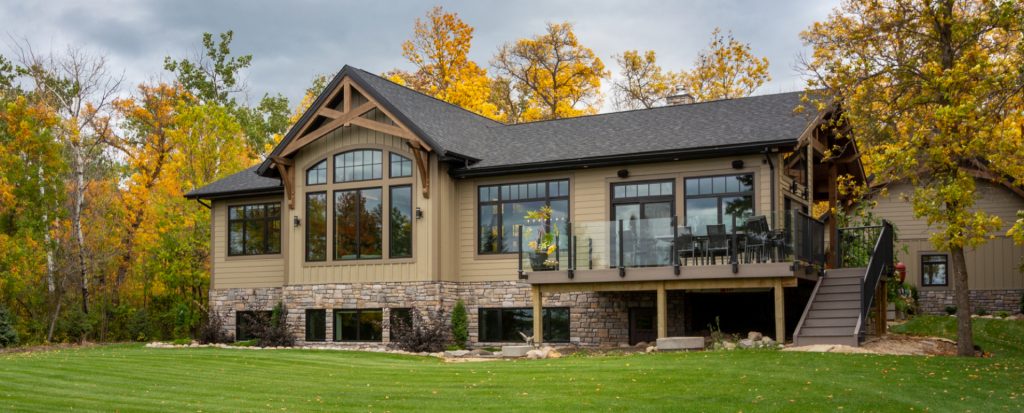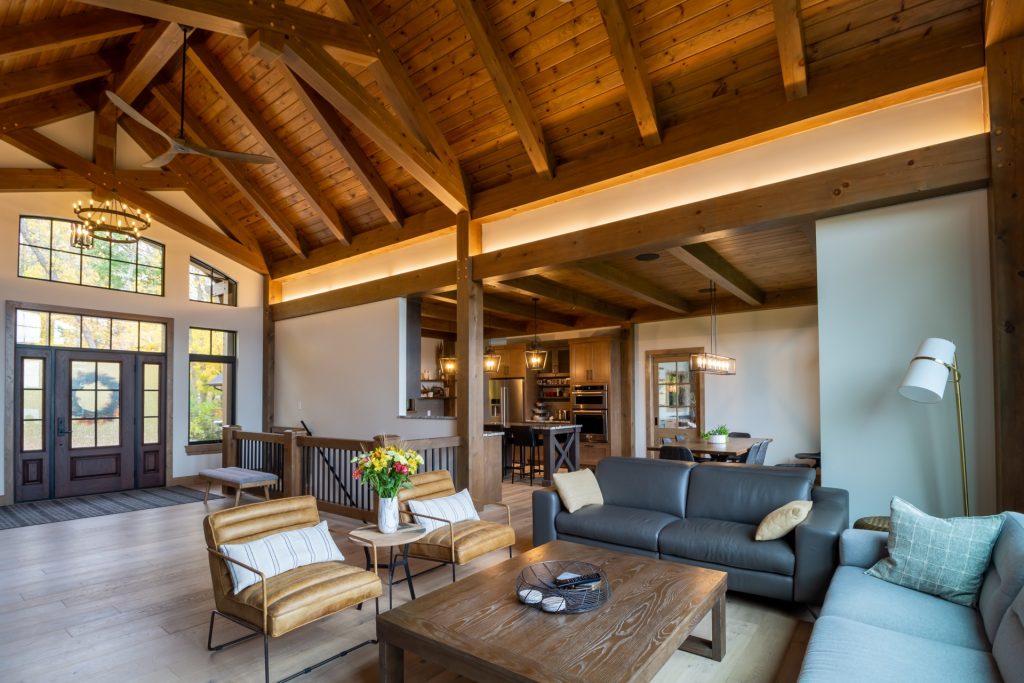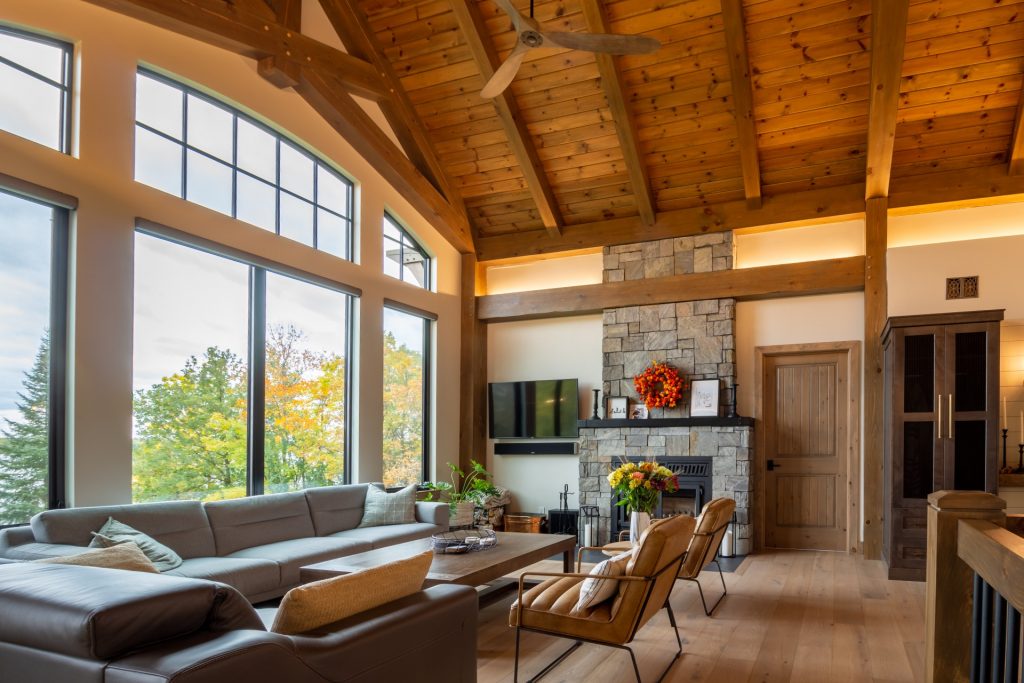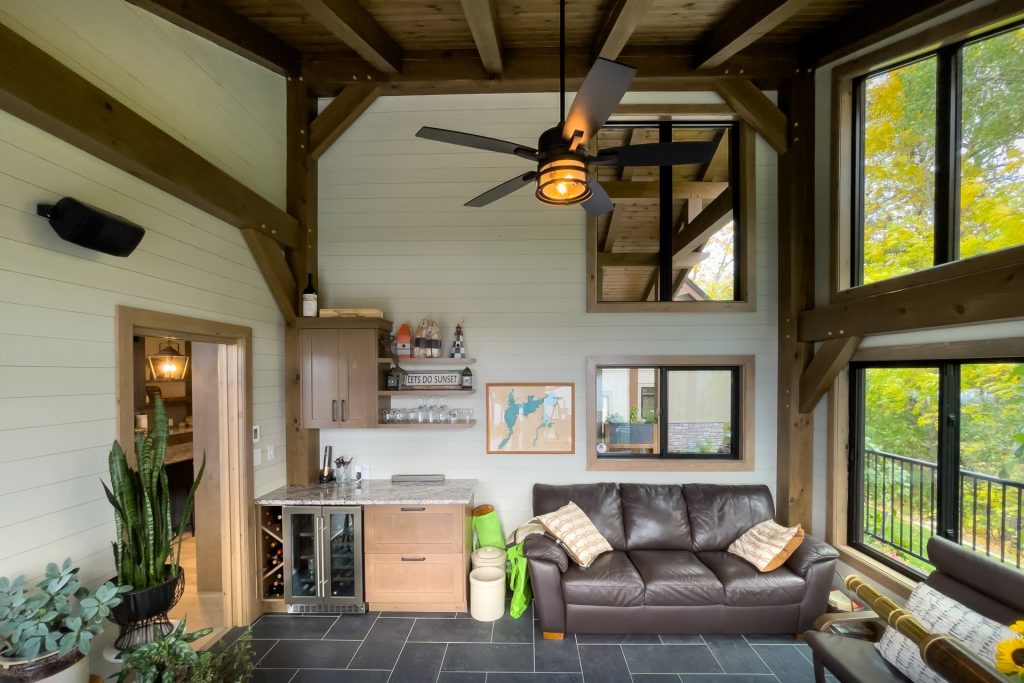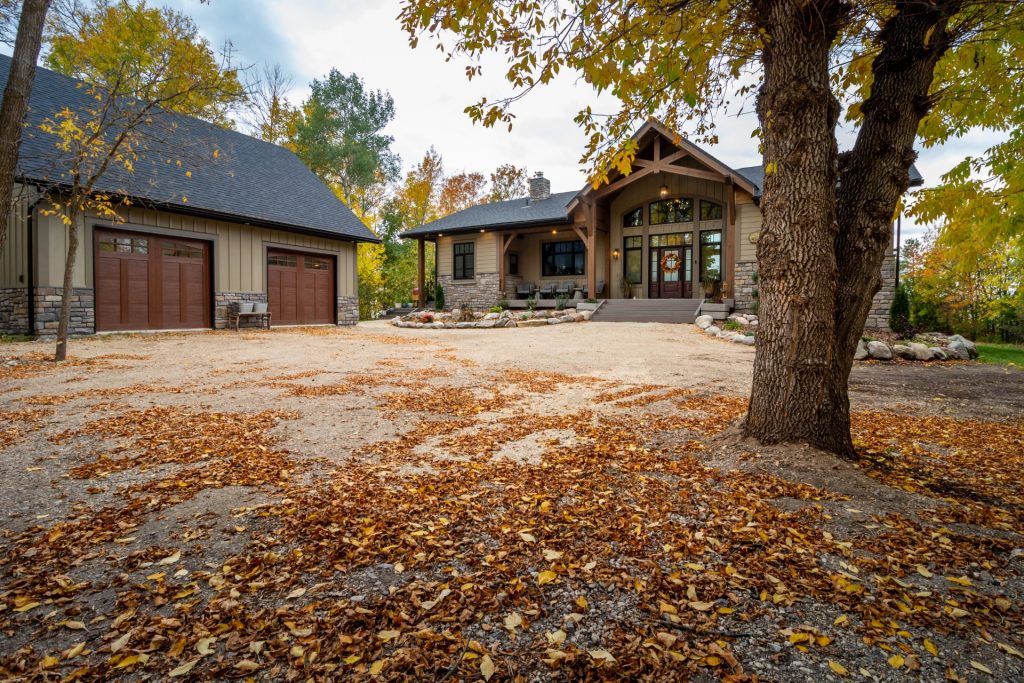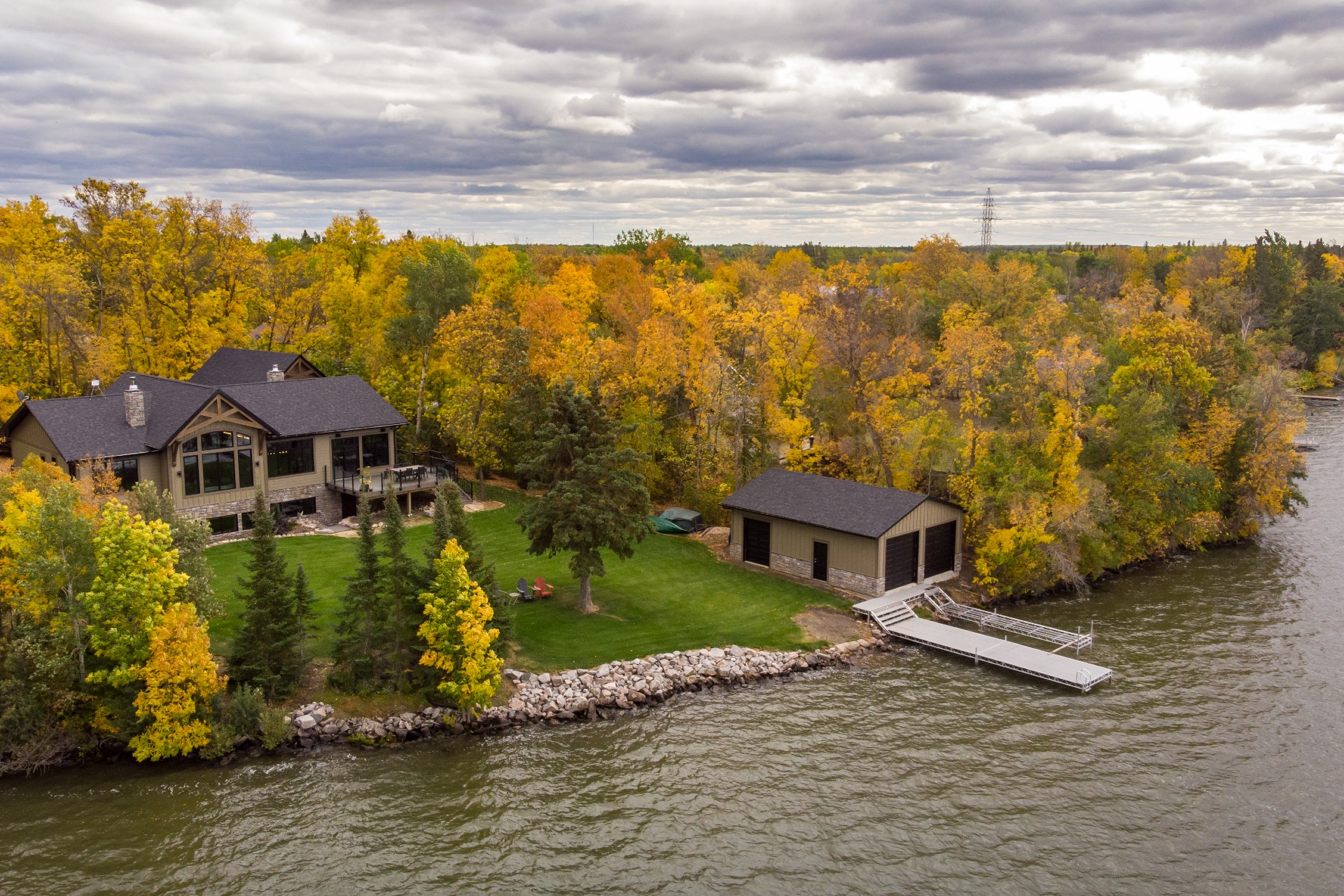
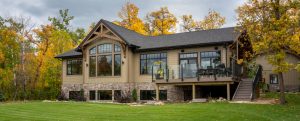
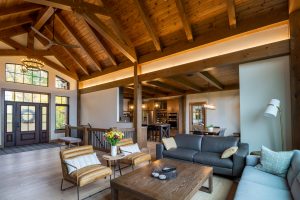
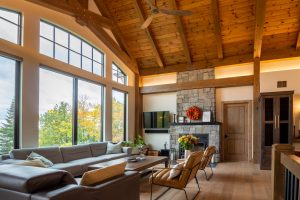
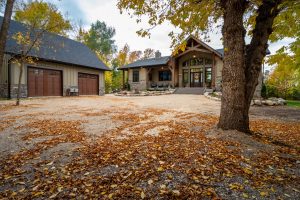
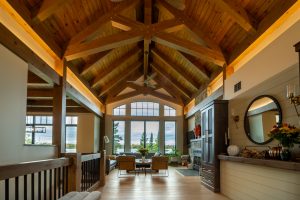
Riverland South is positioned on a manicured riverside lot and engineered as a hybrid timber frame residence. The primary structural feature is a continuous timber frame vault extending from the front entry through the central living areas to the lakeside glazing.
This uninterrupted vaulted structure establishes a clear vertical load path from ridge to foundation. Conventional framing is integrated strategically in secondary zones to optimize cost efficiency and mechanical routing while preserving structural clarity in the primary volume.
Riverside exposure introduces wind uplift, lateral shear and seasonal moisture variation. The structural system is designed to resist these forces through aligned load transfer and reinforced connection detailing.
Continuous Structural Timber Vault
The structural timber frame vault spans from entry to lakeside elevation, creating a single axial volume. Continuous ridge support is maintained through engineered beam sizing and aligned vertical posts.
Engineering considerations include:
-
Snow load distribution across full vault length
-
Ridge beam bending resistance
-
Control of creep deformation in long-span members
-
Lateral stability through diaphragm action
Tall vaulted spaces increase slenderness ratios in supporting posts. Post dimensions are selected to prevent buckling under combined compressive and lateral loads.
Roof diaphragm action stabilizes the structure and distributes wind forces into shear-resisting wall assemblies.
Scissor Brace Trusses: Structural Mechanics and Visual Rhythm
Repeating scissor brace trusses define the main living area. Scissor trusses modify bottom chord geometry to increase ceiling height while controlling horizontal thrust.
Structural behavior includes:
-
Compressive forces in rafters
-
Axial redistribution through scissor geometry
-
Tension and compression balance at brace intersections
-
Reduced mid-span deflection
Connection detailing must resist combined shear and axial forces. Concealed steel plates or reinforced timber joinery ensure joint integrity under sustained snow load.
Round topped windows on the lakeside elevation introduce arched header requirements. Beam sizing above these openings accounts for concentrated vertical load and lateral wind pressure.
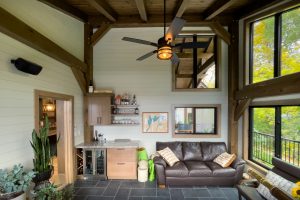
Mono-Sloped Timber Frame Sunroom
The sunroom is constructed as a separate mono-sloped structural timber frame. Mono-slope roofs simplify load paths but concentrate snow load along the lower bearing line.
Engineering priorities include:
-
Reinforced beam sizing at low edge
-
Snow drift evaluation at intersection with main roof
-
Ventilated roof cavity to prevent condensation
Because the sunroom experiences high glazing exposure, thermal expansion between timber and window systems is accommodated through flexible connection detailing.
Continuous load transfer from mono-slope rafters to foundation anchorage maintains structural integrity.
Exterior Timber Integration and Load Transfer
Exterior elements including a covered entry porch, timber framed BBQ porch and scissor brace gable trim details extend structural expression beyond the interior.
These assemblies perform measurable structural roles:
-
Cantilever bending resistance at porch projections
-
Uplift resistance at exposed corners
-
Shear transfer through bracketed connections
Timber brackets convert bending forces into axial compression through triangulated geometry.
Scissor brace gable trim details reinforce gable stability under wind load.
Exterior timber must be protected from moisture intrusion. Flashing integration at beam penetrations and end grain sealing prevent decay.
Flat Ceiling Timber Zones
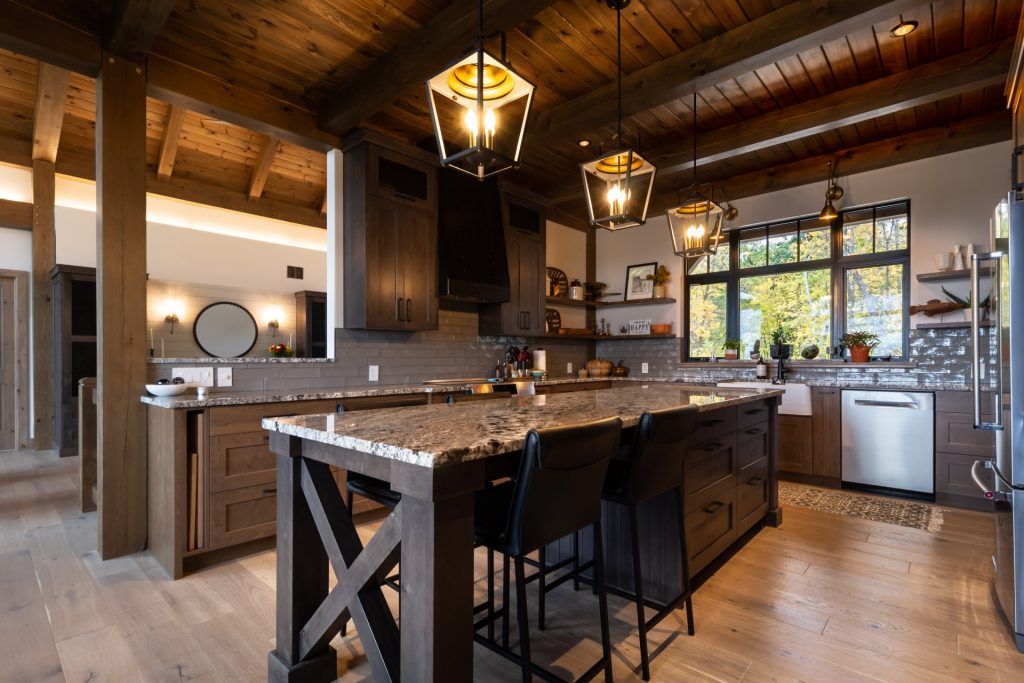
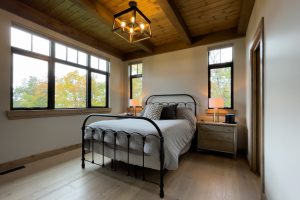
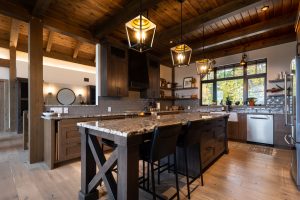
Flat ceiling timber framing over the kitchen, dining area and master bedroom integrates with the vaulted system to create diaphragm continuity.
Engineering implications include:
-
Secondary beam support for ceiling loads
-
Shear transfer across flat ceiling plane
-
Alignment with load-bearing wall systems
Flat timber zones reduce ceiling height variation while maintaining structural grid consistency.
Material Selection and Surface Treatment
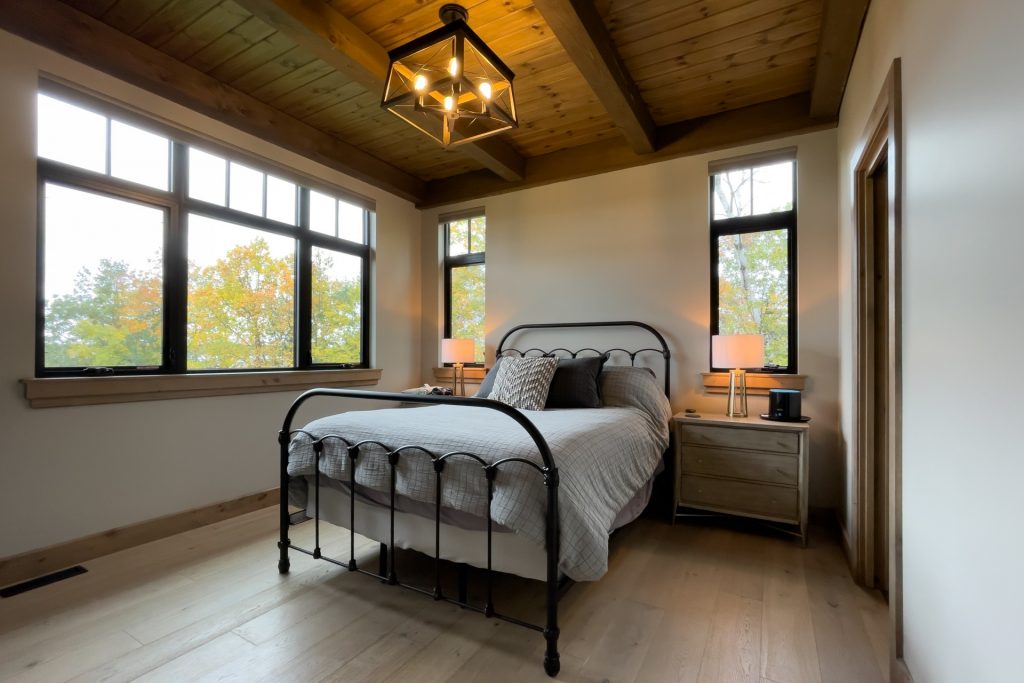
The primary timber species is Eastern white pine. Pine offers favorable workability and moderate structural strength when properly sized.
Performance considerations include:
-
Controlled moisture content at installation
-
Surface sealing to reduce moisture absorption
-
Monitoring of creep deformation under sustained load
Tongue and groove pine boards form the ceiling finish. These boards contribute modest diaphragm action and must be fastened according to structural schedule to prevent seasonal separation.
The boards are stained slightly lighter than the primary timbers to emphasize structural hierarchy without altering performance.
Sansin Greyed Medium Brown finish provides UV protection and surface durability while allowing vapor permeability.
Lighting Integration and Structural Articulation
Strategic uplighting between girts and eave plates enhances visibility of structural elements. While primarily aesthetic, lighting integration requires:
-
Concealed wiring pathways
-
Protection against heat accumulation near timber surfaces
-
Compliance with electrical clearance standards
Lighting does not compromise structural integrity when properly isolated from primary load-bearing members.
Environmental Load and Durability Considerations
Riverland South must resist:
-
Snow load accumulation
-
Wind uplift along river corridor
-
Freeze-thaw cycling
-
Seasonal humidity variation
Structural countermeasures include:
-
Continuous vertical load paths
-
Tension-rated foundation anchors
-
Ventilated roof assemblies
-
Corrosion-resistant connectors
Creep deformation in scissor trusses and ridge beams is incorporated into design calculations to maintain serviceability.
Foundation systems include drainage and frost protection measures to prevent soil movement affecting load alignment.
Structural Summary
Riverland South demonstrates disciplined hybrid timber engineering with:
-
Continuous structural vault from entry to lakeside
-
Repeating scissor brace truss system
-
Mono-slope timber sunroom
-
Exterior porch and gable structures integrated into load path
-
Eastern white pine framing with protected surface finish
The residence achieves structural clarity, environmental resilience and architectural cohesion through precise timber engineering and controlled integration with conventional framing systems.