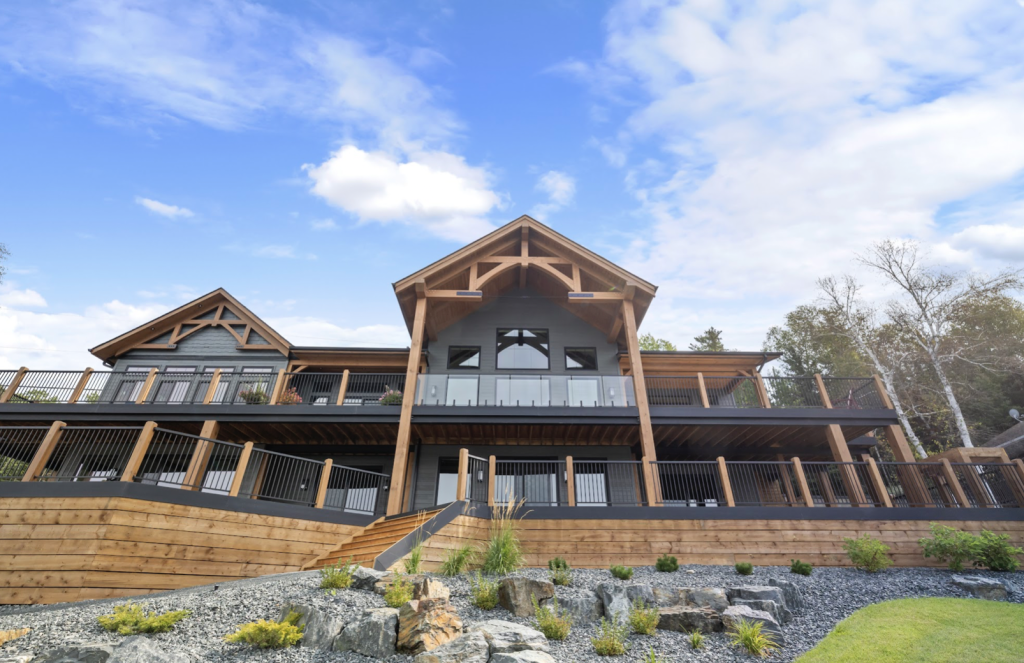

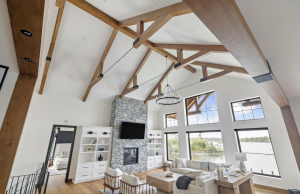
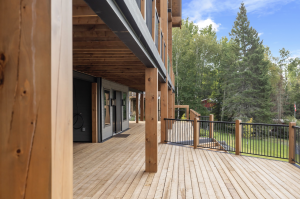
The Longbow residence integrates a lodge-inspired heavy timber exterior with a contemporary interior defined by bright finishes and exposed structural accents. The architectural contrast is supported by a consistent structural logic based on defined load paths, controlled deflection, and environmental adaptation for lakefront exposure.
The primary structural system relies on engineered timber framing elements that carry vertical and lateral loads while shaping spatial hierarchy. Exterior decks, verandas, canopy structures, and interior trusses are not decorative additions. They are structurally resolved components within a coherent heavy timber framework.
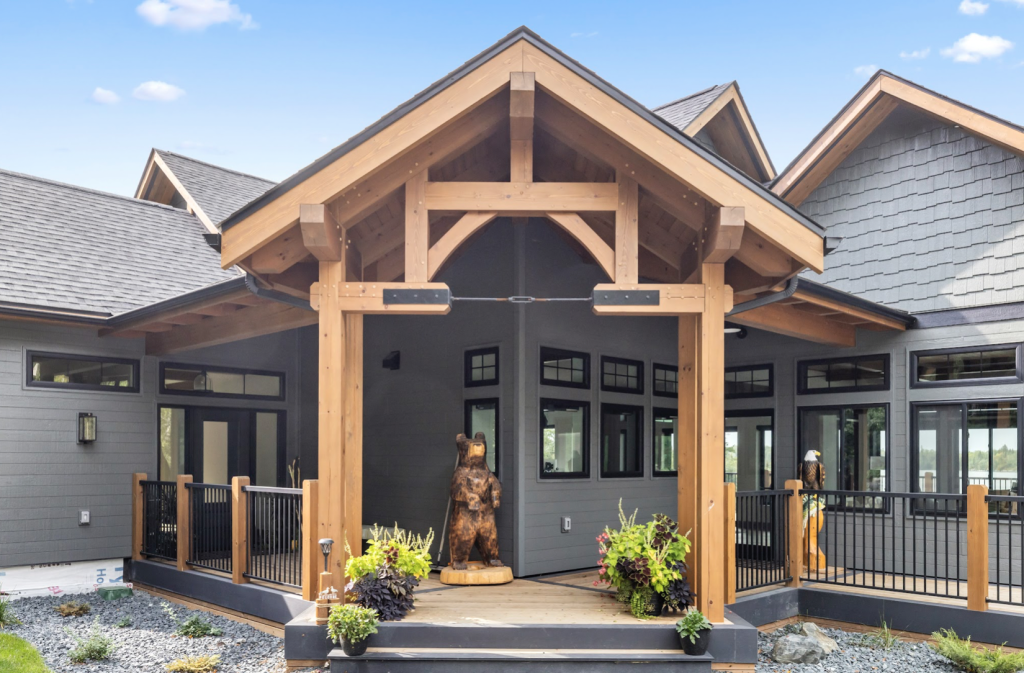
Hammer Beam Entry: Structural Mechanics and Load Resolution
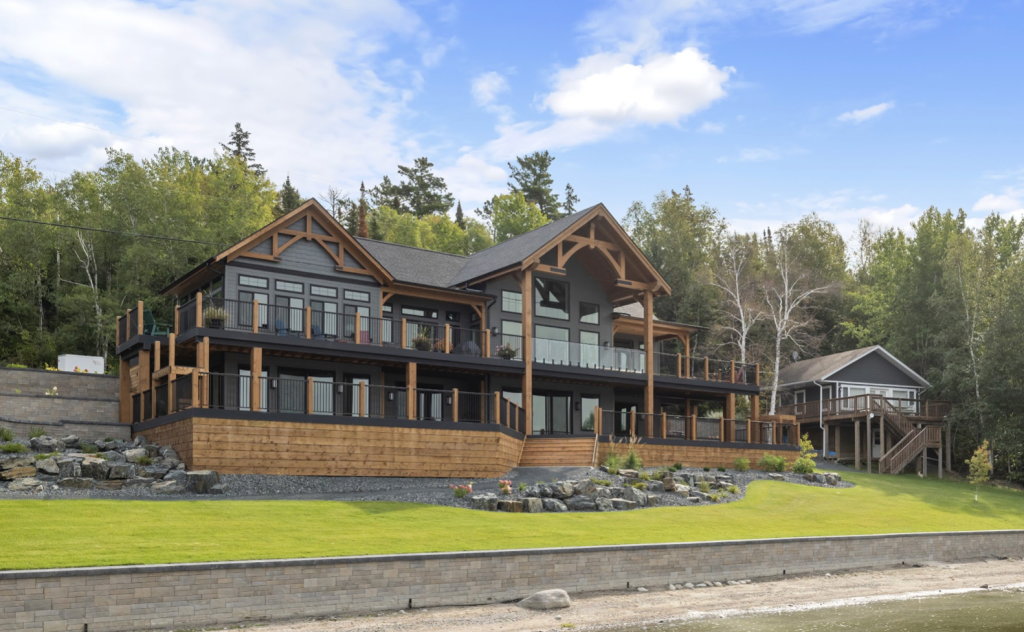
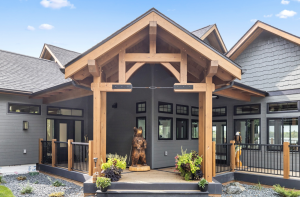
The corner hammer beam entry establishes the structural and architectural identity of the home. Unlike conventional tie-beam systems, hammer beam trusses eliminate a full-span bottom chord while maintaining lateral thrust resistance through short horizontal beams and angled braces.
From an engineering perspective, hammer beam assemblies:
-
Reduce outward thrust on supporting walls
-
Transfer roof loads through angled braces into vertical posts
-
Create compressive force vectors resolved at bracket intersections
-
Limit bending moment through triangulated geometry
Connection detailing is critical. Mortise and tenon joints or concealed steel knife plates must resist axial compression, shear forces, and long-term creep deformation under sustained roof load.
Positioned at the corner of a walk-around deck, the hammer beam entry must also address wind-driven lateral loading. Lakefront wind exposure amplifies torsional stress at corners. Proper post anchorage and uplift-rated connectors ensure structural stability.
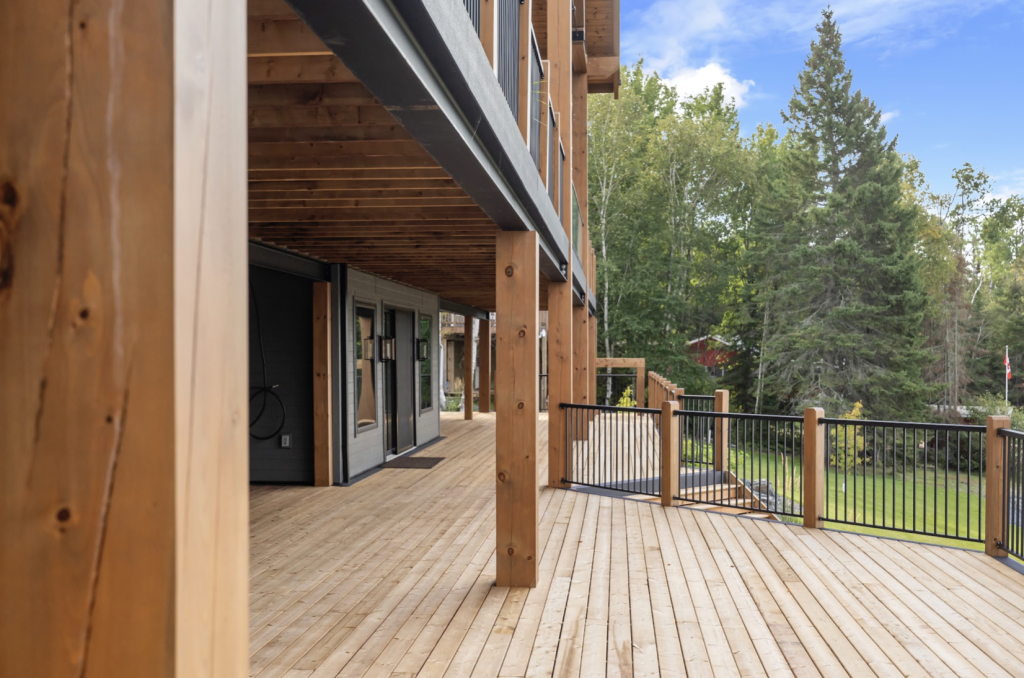
Walk-Around Deck and Lakeside Canopy Engineering
The perimeter deck introduces distributed live loads from occupancy and concentrated loads from canopy supports. Deck framing must account for:
-
Snow accumulation in winter conditions
-
Uplift forces at roof extension
-
Differential movement between primary structure and deck
The generous lakeside deck includes a high timber canopy extending from the main living area. This canopy introduces cantilevered bending forces and wind uplift pressure.
Structural mitigation includes:
-
Continuous load path from canopy rafters to primary posts
-
Braced beam-to-post geometry
-
Corrosion-resistant connectors suitable for humid lake environments
Drainage slope and flashing integration prevent moisture intrusion at wall intersections. Proper ventilation below decking mitigates moisture accumulation and decay risk.
The two flanking verandas expand seating capacity while maintaining lateral balance across the facade. Symmetrical load distribution reduces eccentric stress on the main structural frame.
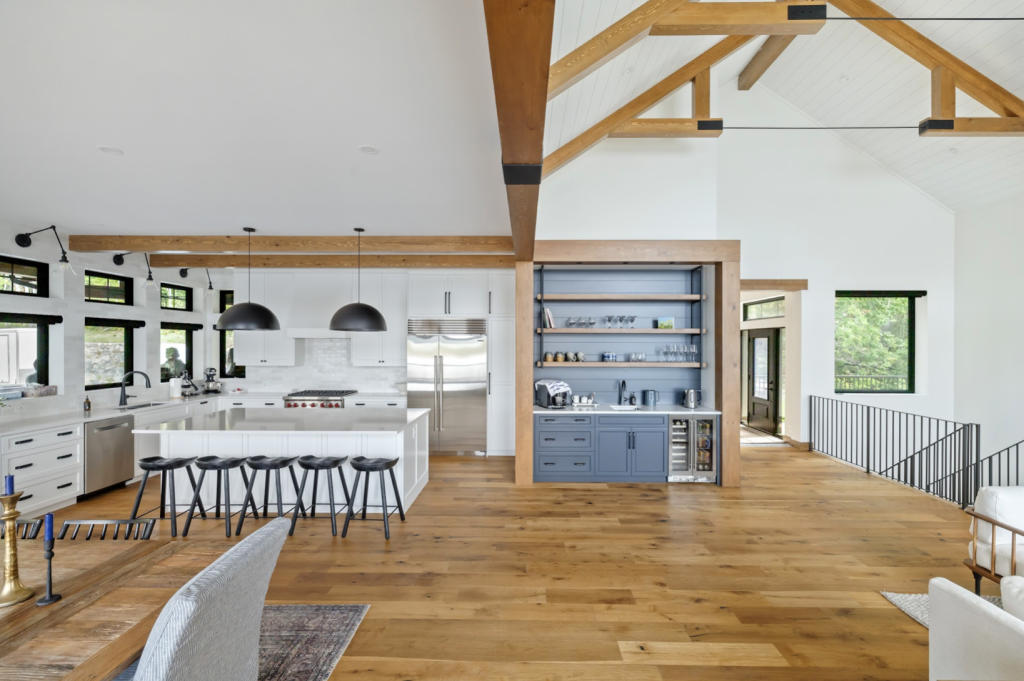
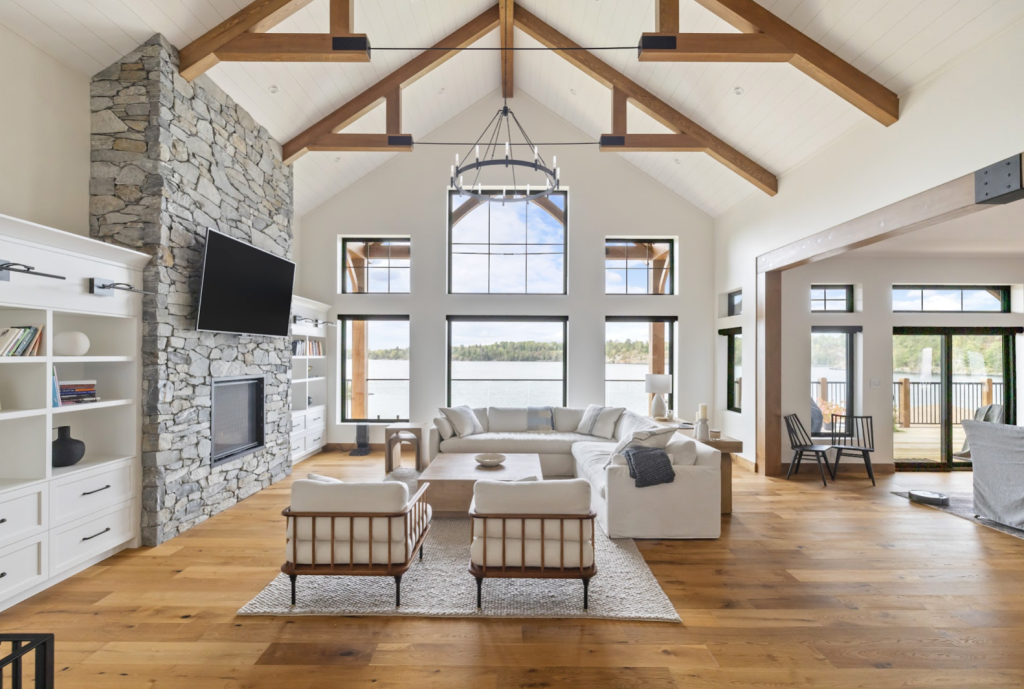
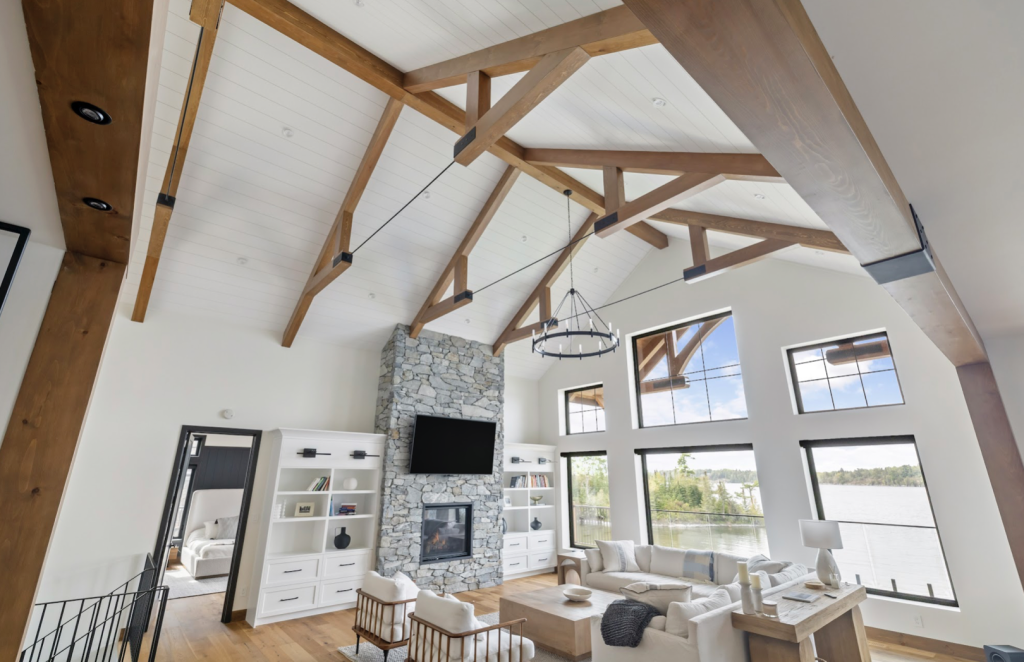
Repetition of Hammer Beam Motif in Interior Structure
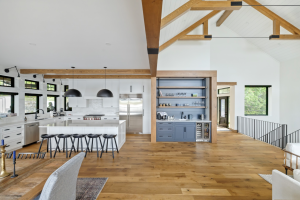
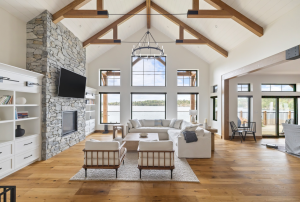
Interior timber accents replicate the hammer beam truss geometry. These elements serve both structural and stabilizing roles.
Within the main living volume, timber components:
-
Transfer roof loads downward through aligned posts
-
Provide diaphragm stiffness
-
Reduce deflection across wide spans
Heavy timber members are sized according to span length, expected snow load, and allowable deflection limits. Creep deformation is accounted for during design, particularly in members subjected to sustained compressive forces.
The visual contrast between warm timber tones and bright white ceilings does not alter the mechanical function of the structure. Timber remains a load-bearing system integrated with the building envelope.
Humidity control within the interior environment protects timber members from excessive seasonal expansion and contraction. Controlled ventilation supports dimensional stability and long-term serviceability.
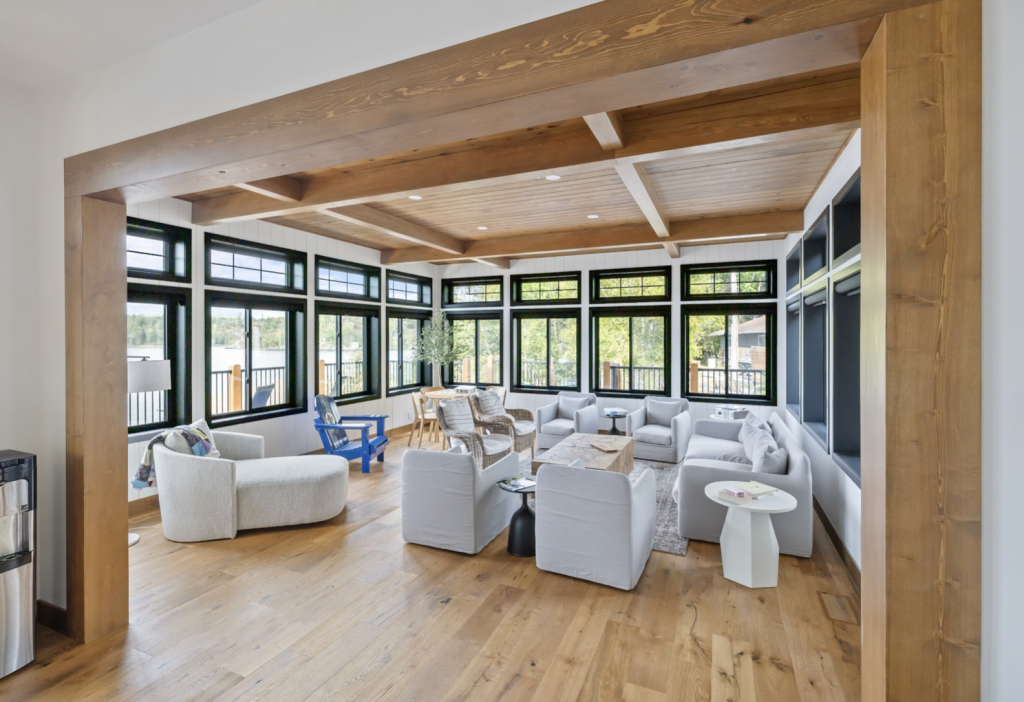
Four-Season Sunroom: Envelope and Structural Performance
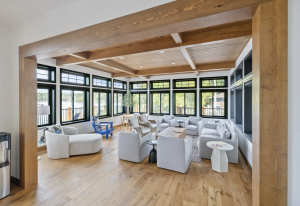
The large four-season sunroom extends the conditioned footprint and introduces increased glazing surface area. Structurally, it must maintain continuity with the main roof diaphragm and vertical support grid.
Engineering considerations include:
-
Roof framing sized for snow load accumulation
-
Lateral bracing against wind pressure
-
Thermal break integration at glazing interfaces
-
Air barrier continuity around beam penetrations
Exposed ceiling beams and wood planks contribute additional dead load. Beam sizing incorporates density, moisture content, and long-term creep factors.
Solar gain in a four-season sunroom must be controlled to prevent overheating during peak exposure. Ventilation and shading strategies mitigate interior heat buildup while preserving daylight access.
Condensation risk is addressed through:
-
Insulated glazing units
-
Proper vapor control
-
Ventilated roof cavities
These measures maintain structural integrity of timber elements adjacent to glazing.
Environmental Durability and Load Path Integrity
The Longbow residence operates in a lakefront climate characterized by:
-
Snow load and drift accumulation
-
Wind uplift and lateral shear
-
High humidity
-
Freeze-thaw cycling
Heavy timber framing performs predictably under these conditions due to mass and redundancy. Continuous vertical load paths from roof to foundation prevent structural discontinuities.
Deck and canopy assemblies incorporate uplift-resistant anchorage and corrosion-protected fasteners to withstand environmental cycling.
Moisture management detailing at beam-to-wall intersections ensures water shedding and prevents capillary absorption into structural members.
Structural Summary
The Longbow project demonstrates disciplined integration of hammer beam timber framing within a contemporary architectural context.
Key performance attributes include:
-
Lateral thrust management through hammer beam geometry
-
Uplift resistance at exposed lakefront corners
-
Balanced load distribution across deck and veranda systems
-
Sunroom integration with controlled thermal and moisture behavior
Rather than blending styles superficially, the structure blends structural mechanics with architectural expression. The hammer beam motif functions as a repeated load-bearing strategy, reinforcing structural integrity while defining spatial character.
The result is a durable, performance-driven lake residence where timber framing remains the central structural system supporting both exterior and interior architectural intent.