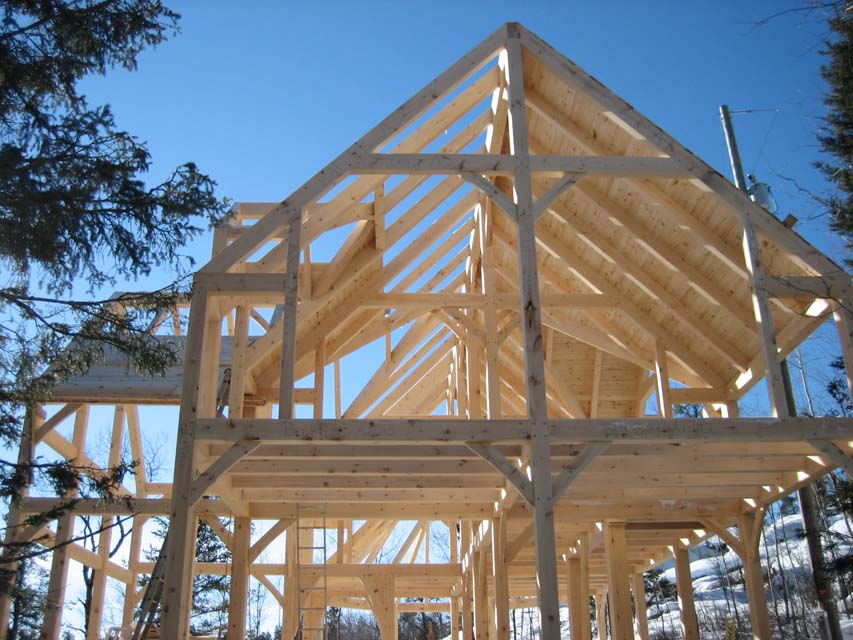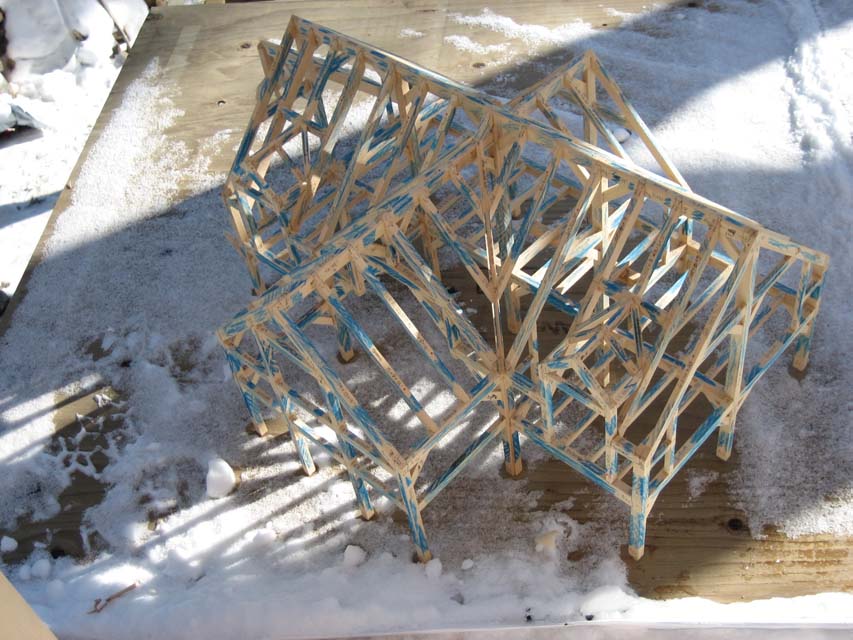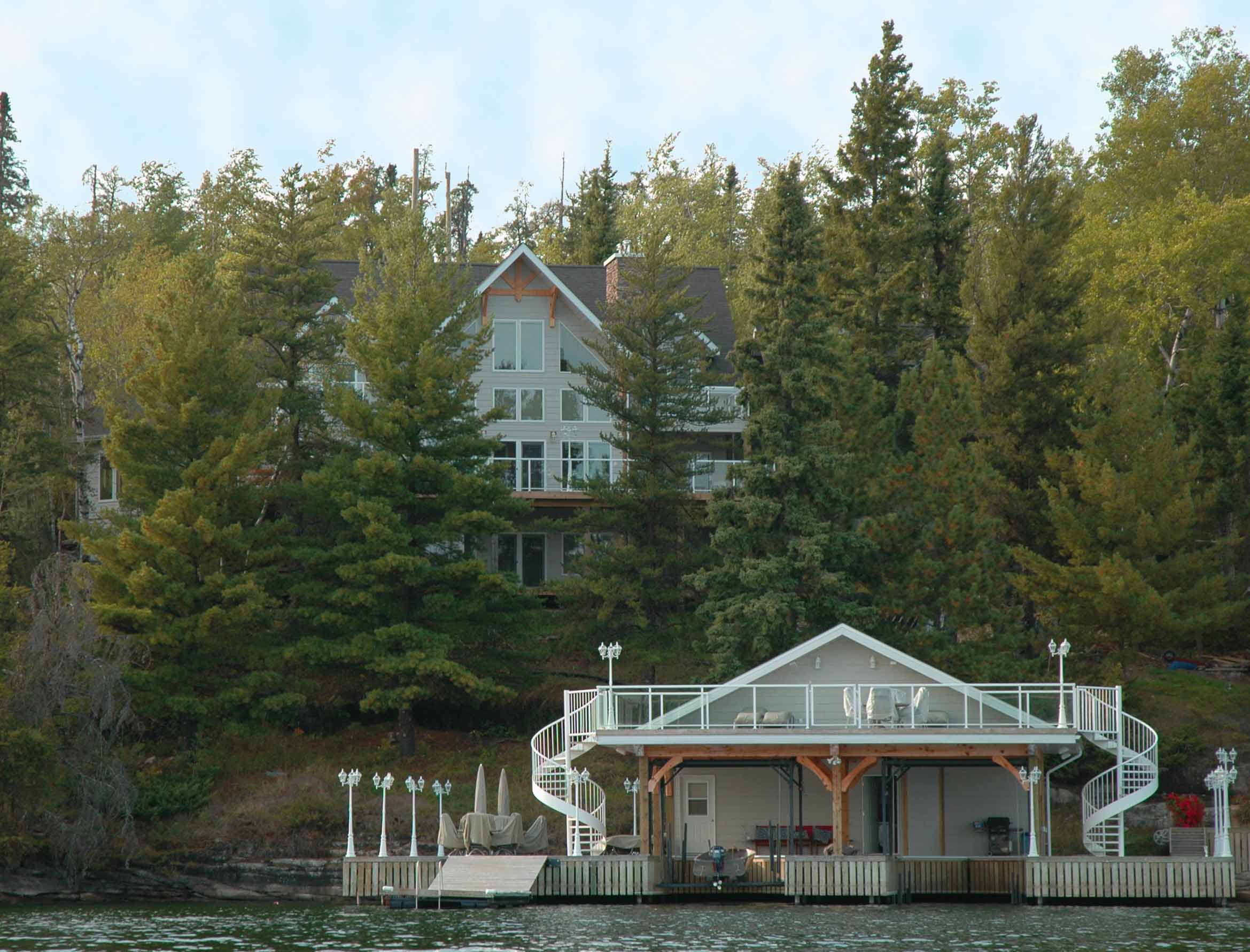
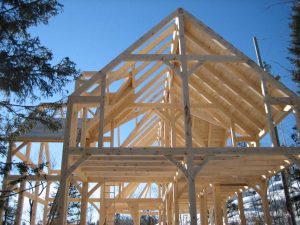
Hidden Cove is organized around a classic cross-gabled roof configuration. Cross-gabled geometry introduces intersecting roof planes that require careful valley framing, drift load analysis and diaphragm continuity.
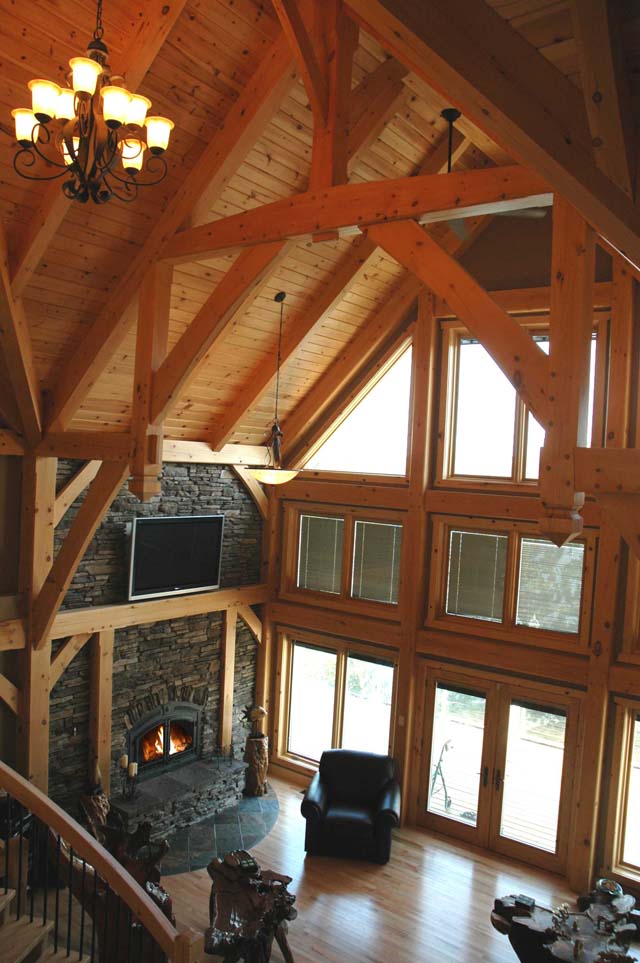
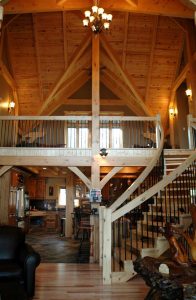
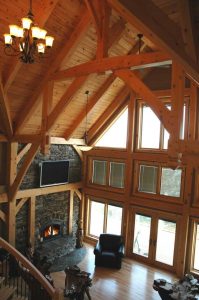
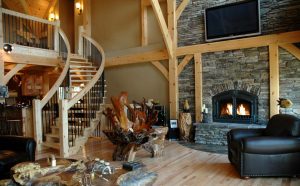
At the center of the structure is a 24 ft x 22 ft great room spanned by a hammer beam truss. The design prioritizes long-span performance, uninterrupted lake views and visible structural expression.
The structural system is heavy timber framing with traditional joinery enhanced by engineered load analysis.
24 ft x 22 ft Great Room: Hammer Beam Truss Mechanics
The great room is carried by a hammer beam truss spanning 24 ft. Hammer beam trusses allow vertical height without a full-span tie beam, increasing interior volume while controlling horizontal thrust.
Structural behavior includes:
-
Compressive forces in rafters
-
Tension and compression in hammer beams and struts
-
Outward thrust resolved through post anchorage
-
Shear transfer at mortise-and-tenon joints
For a 24 ft span, member sizing accounts for:
-
Regional snow load
-
Dead load from roof decking and insulation
-
Wind uplift and lateral pressure
-
Long-term creep deformation
Post bases must resist combined axial compression and horizontal thrust. Anchoring systems ensure stability under wind exposure.
Deflection limits are controlled to protect glazing interfaces and prevent joint loosening over time.
Cross-Gabled Roof and Valley Framing
Cross-gabled design requires structural coordination at valley intersections. Roof valleys concentrate snow accumulation and increase localized load.
Engineering considerations include:
-
Reinforced valley rafters
-
Drift load evaluation
-
Shear continuity across roof diaphragm
-
Proper flashing and drainage detailing
Valley framing members are sized to resist increased bending stress from accumulated snow.
Continuous roof sheathing ties intersecting gables into a unified diaphragm resisting lateral wind forces.
Curving Stairway: Structural and Spatial Role
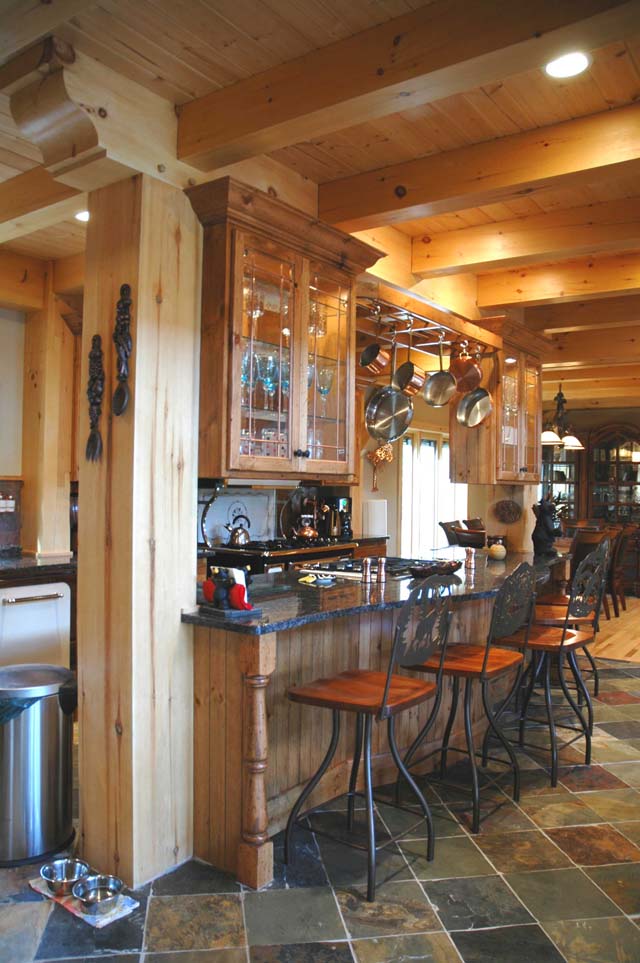
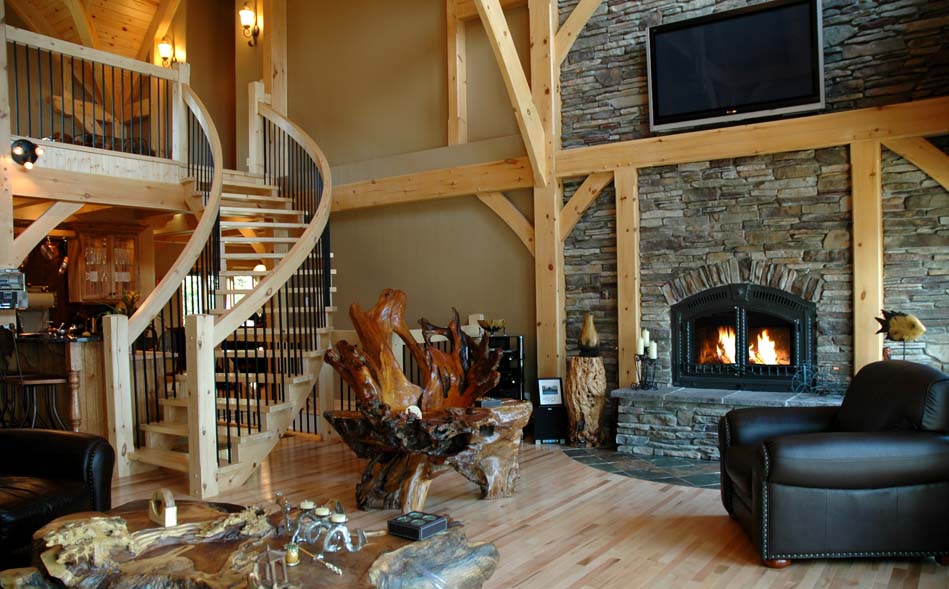
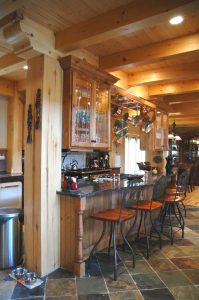
A curving stairway to the loft delineates the kitchen from the great room while preserving sight lines to the lake.
From a structural perspective:
-
Stair framing must resist torsional load along curved geometry
-
Stringers require reinforced anchorage into floor diaphragm
-
Guardrail posts integrate with timber framing grid
Curved stair geometry introduces eccentric loading that must be resolved into floor beams without inducing differential movement.
Half-Octagon Snooker Room: Radial Roof Confluence
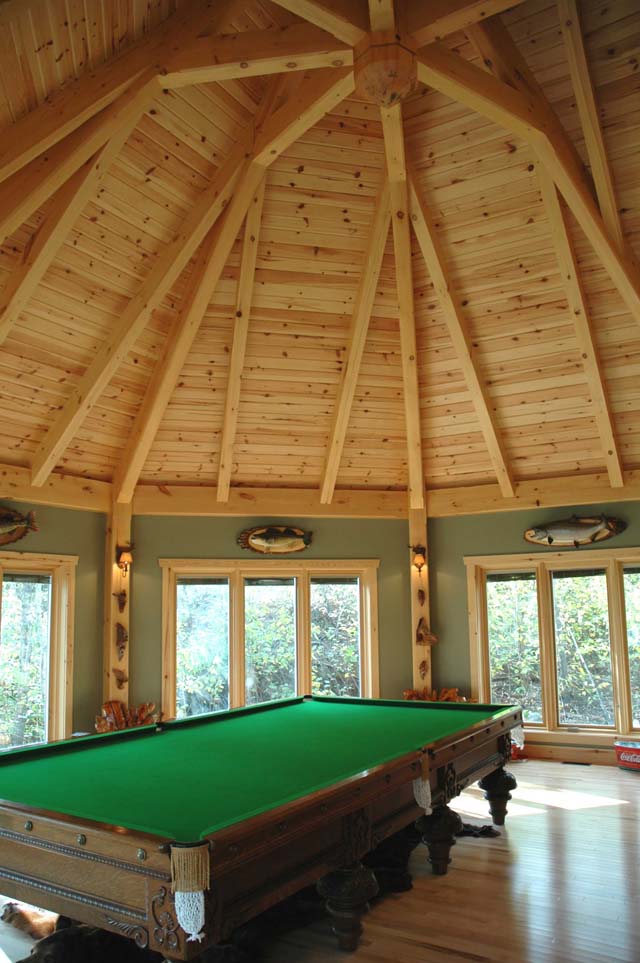
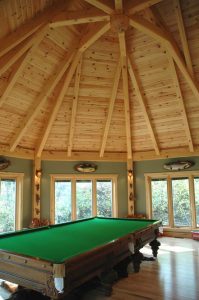
The half-octagon snooker room is engineered to accommodate a championship table. Clear floor area requires long-span support without interior posts.
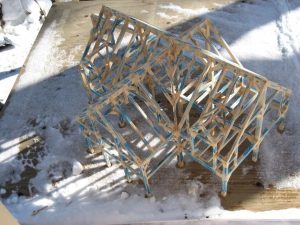
Structural complexity arises at the roof where rafters converge toward a central boss pin.
Engineering characteristics include:
-
Radial rafter layout distributing compressive force to perimeter walls
-
Central boss pin functioning as compression hub
-
Balanced load distribution across octagonal geometry
Snow load drift at roof transitions is evaluated due to multi-directional slopes.
Floor framing beneath the snooker table is reinforced to prevent deflection that could affect level play surface.
Traditional Joinery and Mechanical Performance
Hidden Cove features extensive traditional joinery, including:
-
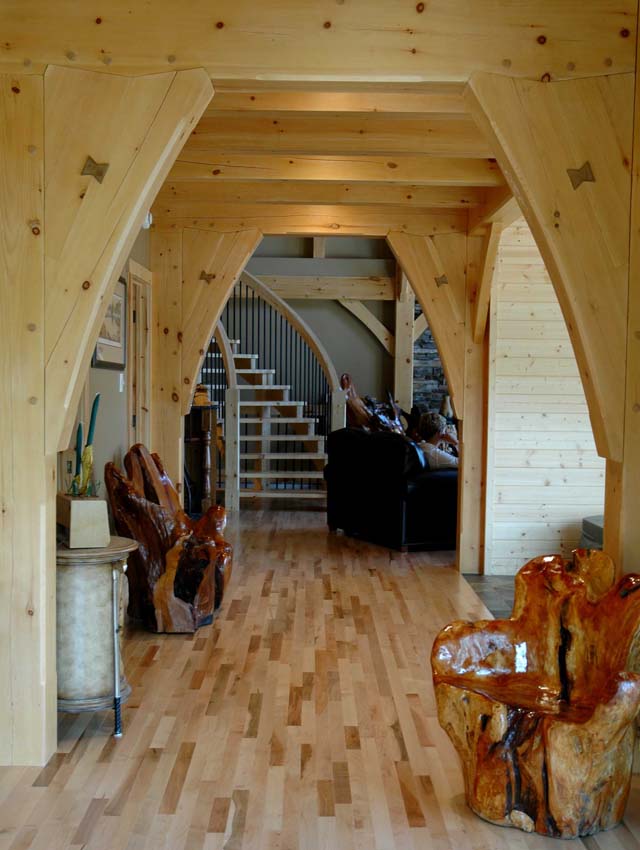
Thru tenons
-
Carved beam ends
-
Oak butterfly keys
Thru Tenons
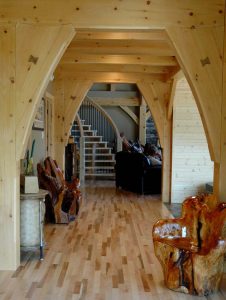
Thru tenons transfer shear and axial forces between intersecting members. Proper tenon sizing preserves net section strength and prevents stress concentration.
Carved Beam Ends
Carved profiles reduce cross-sectional area at beam ends. Engineering evaluation ensures remaining section modulus satisfies bending stress requirements.
Oak Butterfly Keys
Butterfly keys serve both aesthetic and structural roles. Mechanically, they:
-
Arrest crack propagation
-
Resist separation along natural timber checking
-
Provide lateral clamping force
Oak is selected for higher density relative to primary timber species, increasing locking capacity.
All joinery is engineered to account for timber shrinkage and seasonal moisture variation.
Environmental and Durability Considerations
Lakefront conditions introduce:
-
Snow load accumulation
-
Wind uplift across open exposure
-
Freeze-thaw cycling
-
Seasonal humidity fluctuation
Structural countermeasures include:
-
Continuous load paths from ridge to footing
-
Uplift-rated hold-down anchors
-
Ventilated roof cavities
-
End grain sealing
Moisture content is controlled at fabrication and installation to reduce shrinkage-induced joint stress.
Structural Summary
Hidden Cove demonstrates integrated timber engineering through:
-
24 ft hammer beam truss spanning a 24 ft x 22 ft great room
-
Cross-gabled roof with reinforced valley framing
-
Half-octagon snooker room with central boss pin load convergence
-
Curved stair integrated into structural grid
-
Traditional joinery reinforced by mechanical analysis
The residence combines geometric complexity, long-span performance and traditional timber craftsmanship within a disciplined structural framework designed for lakefront durability.