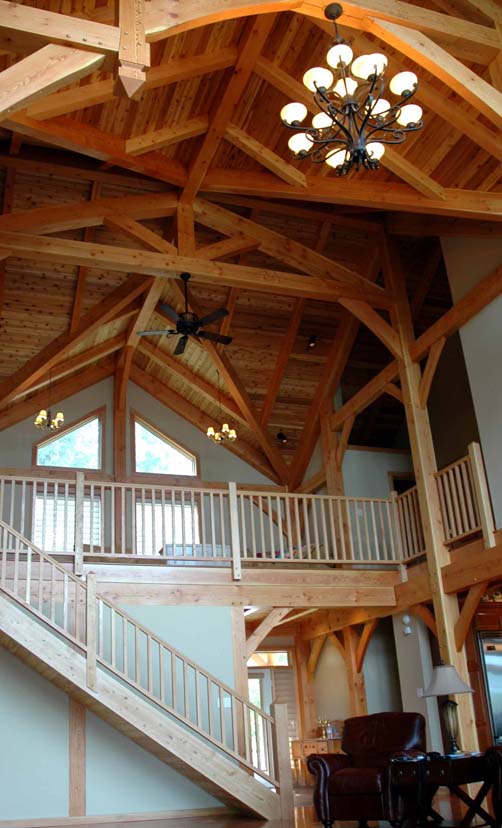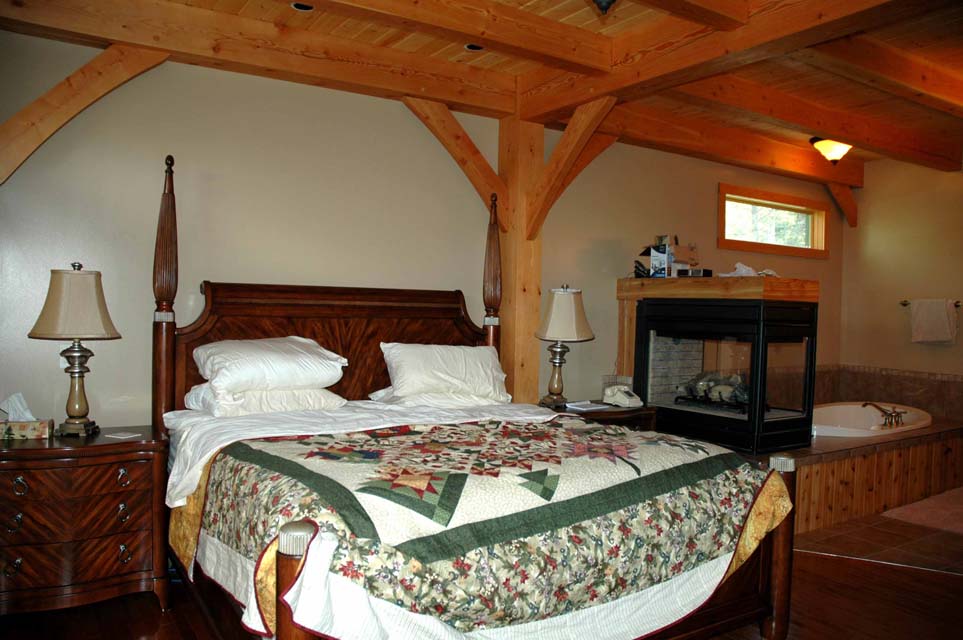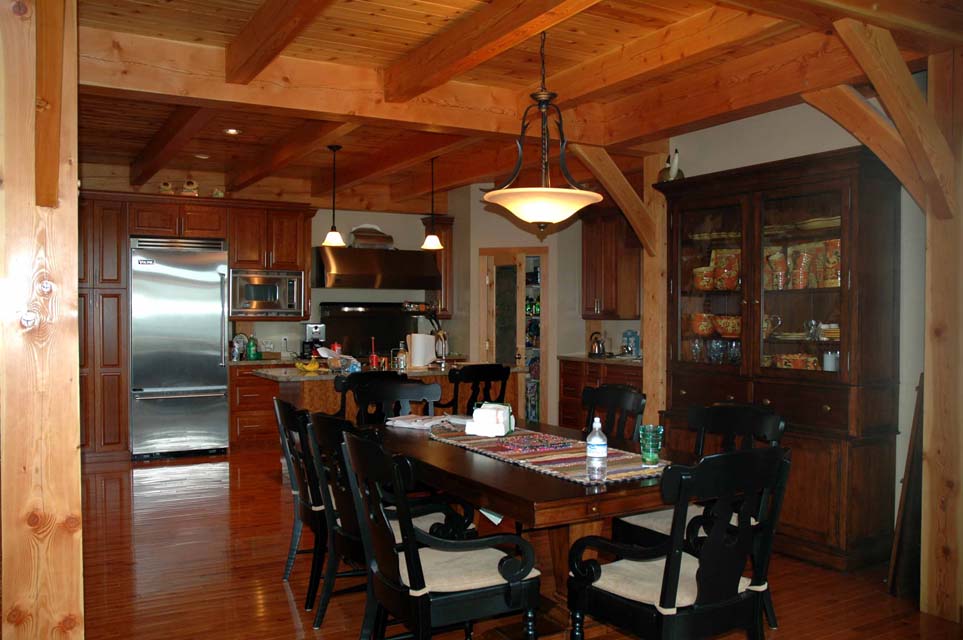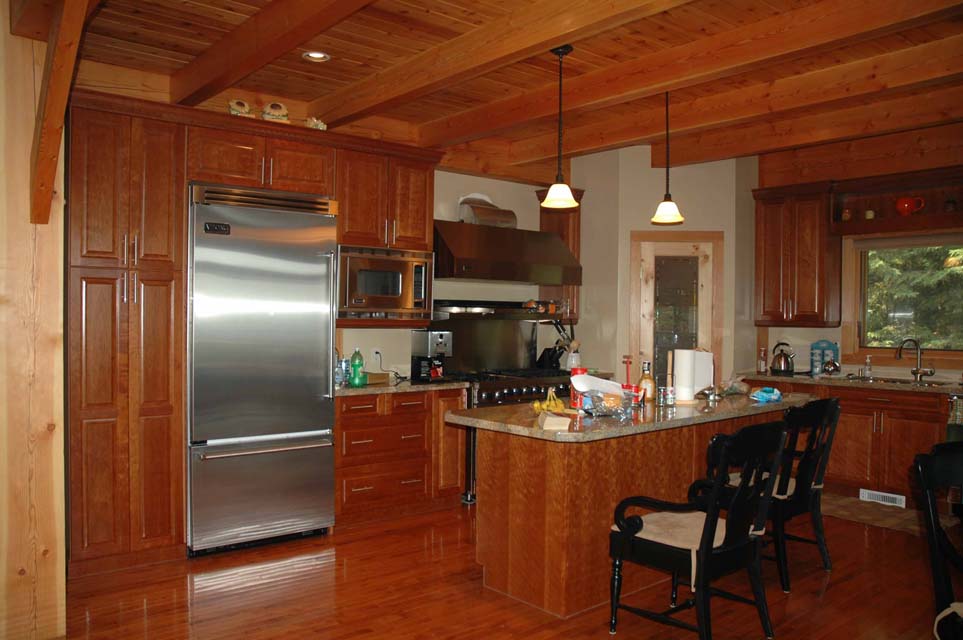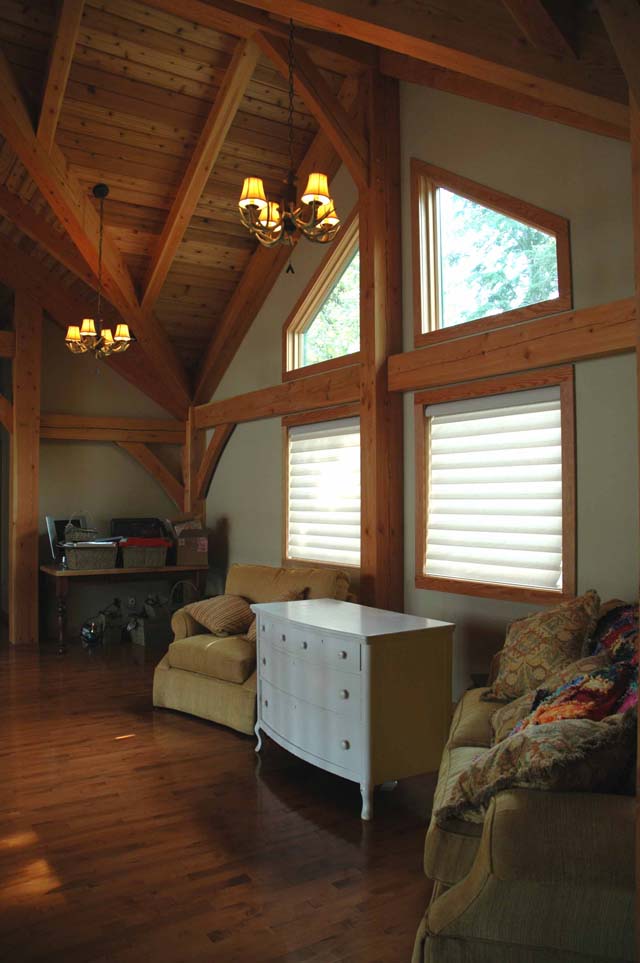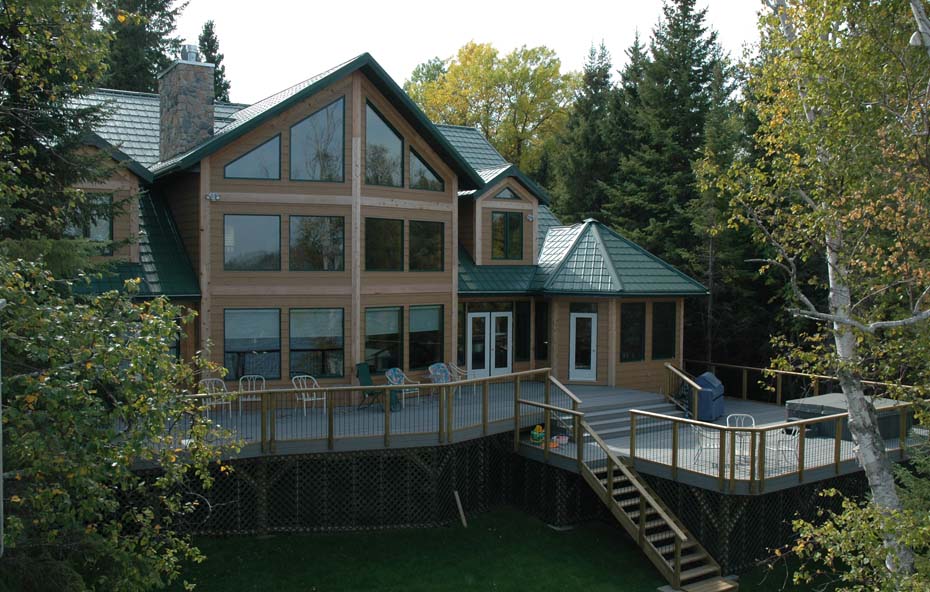


Falcons Nest is engineered as a classic two-storey timber frame cottage organized around a central lake-facing living volume with flanking side wings housing the kitchen, dining area and bedrooms. The structural configuration concentrates heavy timber framing in the primary vaulted space while distributing secondary loads through aligned wing assemblies.
The structural objective is to maintain uninterrupted lake views from both main and loft levels while preserving clear vertical load paths and controlling long-term deflection.
Primary timber species is Douglas fir, selected for its high bending strength and dimensional stability.
Cross-Gable Roof Geometry and Chevron Rafter Confluence
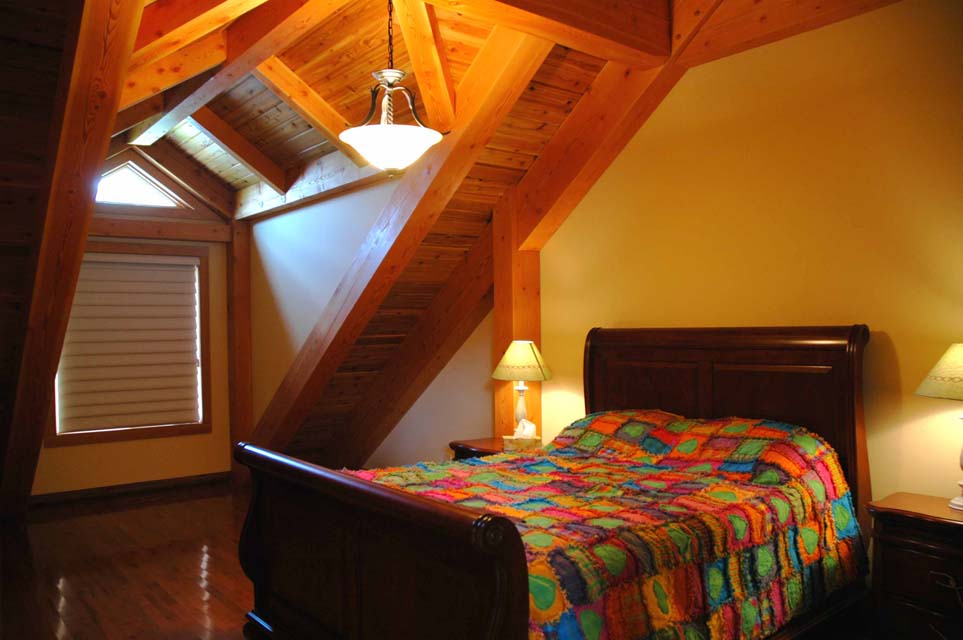
The residence features a cross-gable roof configuration. Where the main vaulted roof intersects with the side wings, rafters converge to create a chevron pattern above the loft.
Cross-gable geometry introduces several engineering considerations:
-
Concentrated load at valley intersections
-
Snow drift accumulation at roof transitions
-
Shear continuity across intersecting diaphragms
-
Reinforced valley rafters
The chevron rafter confluence requires precise fabrication tolerances to ensure load distribution remains symmetrical and eccentric loading is minimized.
Roof diaphragm sheathing ties all intersecting planes together to resist lateral wind forces.
Hammer Beam Truss: Great Room Span and Load Transfer
The great room is spanned by a hammer beam truss, eliminating the need for a full-width tie beam and increasing ceiling height while maintaining structural integrity.
Structural mechanics of the hammer beam truss include:
-
Compressive forces in principal rafters
-
Horizontal thrust managed through hammer beams
-
Axial compression in vertical struts
-
Reinforced beam-to-post anchorage
For a lakefront setting, calculations incorporate:
-
Regional snow load
-
Dead load from roof deck and insulation
-
Wind uplift and lateral pressure
-
Long-term creep deformation
The hammer beam truss ensures unobstructed sightlines from the loft to the lake by eliminating intermediate structural supports.
Post bases are engineered to resist both axial compression and horizontal thrust generated by vault geometry.
Two-Storey Timber Frame Organization
The central living area rises through two storeys, requiring coordinated vertical load stacking.
Engineering priorities include:
-
Alignment of loft floor framing with primary timber posts
-
Reinforced beam sizing beneath upper-level loads
-
Deflection control to protect glazing interfaces
The flanking wings distribute additional dead and live loads through conventional bearing walls integrated into the timber grid.
Hybrid load alignment ensures efficient material use without compromising structural clarity in the central volume.
Loft Visibility and Structural Stability
The loft overlooks the great room and benefits from unobstructed views through the hammer beam truss.
Structural implications include:
-
Reinforced loft floor framing
-
Guardrail anchorage integrated into timber posts
-
Diaphragm continuity between levels
The loft contributes to lateral stiffness by connecting opposing roof planes.
Material Performance: Douglas Fir and Western Red Cedar
Douglas fir timbers provide:
-
High modulus of elasticity
-
Strong bending capacity
-
Predictable shrinkage behavior
The ceiling is finished with knotty western red cedar tongue and groove boards. Cedar offers:
-
Lightweight decking
-
Moisture resistance
-
Dimensional stability
From a structural perspective:
-
T+G boards provide minor diaphragm contribution
-
Proper fastening patterns prevent separation
-
Moisture content must be controlled at installation
Contrasting species create visual differentiation while maintaining structural performance.
Environmental Load Considerations
Lakefront exposure introduces:
-
Snow accumulation and drift
-
Wind uplift across open water
-
Freeze-thaw cycling
-
Seasonal humidity variation
Structural countermeasures include:
-
Continuous load paths from ridge to foundation
-
Reinforced valley framing
-
Uplift-rated foundation anchorage
-
Ventilated roof cavity
Creep deformation in long-span members is incorporated into serviceability analysis to preserve structural alignment.
Foundation systems include frost protection and drainage control to prevent differential settlement.
Structural Summary
Falcons Nest demonstrates disciplined timber engineering through:
-
Cross-gable roof geometry with chevron rafter convergence
-
Hammer beam truss spanning the great room
-
Two-storey central timber frame with flanking wing integration
-
Douglas fir structural members paired with cedar ceiling decking
-
Reinforced valley and diaphragm continuity
The residence achieves open lake views, structural clarity and environmental resilience within a classic two-storey timber frame configuration.