July 24, 2026
Nobody Budgets for This Decision, and Then Somebody Asks the Question
Most people planning a timber frame home spend months on floor plans, window placement, and site orientation. Almost none of them arrive at their first conversation with a fabricator already knowing which wood species they want.
Then the question gets asked, and it feels bigger than it should. It is not. Three species cover the overwhelming majority of the timber frame homes Cornerstone Timberframes builds, and each one solves a different problem.
White Pine Is the Default Because It Solves the Most Common Problem
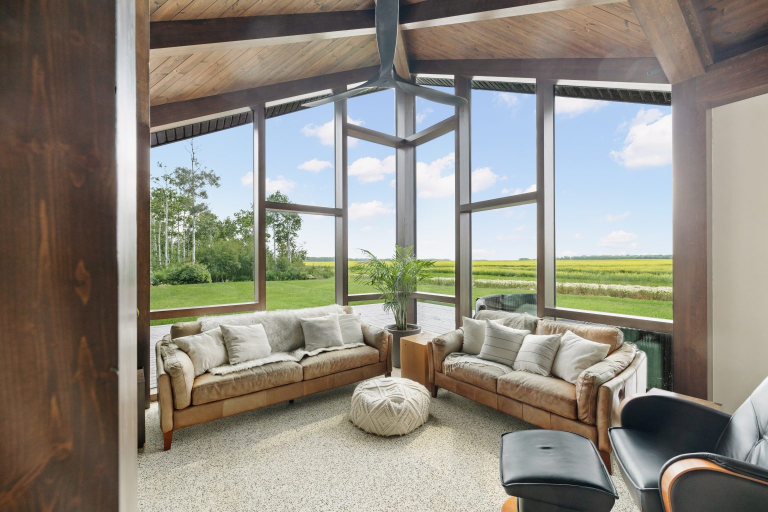
Western White Pine is what most Cornerstone Timberframes clients end up choosing, and the reason is not sentimental. It is a warm, blonde wood with an even, clean grain that does not compete with a room. It frames the space rather than dominating it.
It also takes stain consistently, which matters more than it sounds like it should. A client who wants a natural finish, a rich amber, a cool grey, or something close to white can get there with the same species. That flexibility removes a decision point most homeowners did not know they would need to revisit later.
White Pine is also the most affordable of the three primary species. For a project where budget is doing real work in the decision, this is where most people land, not as a compromise, but as the option that does the most for the least.
Douglas Fir Costs More Because the Wood Itself Is Doing More
Douglas Fir runs about 25 percent above White Pine, and that premium buys two distinct things.
The first is visual character. Fir carries pink and red tones through the grain that White Pine does not have, with a more pronounced figure overall. Clients who walk into a timber frame space and stop to look twice at the wood itself are usually looking at Douglas Fir. Some build an entire interior palette around it.
The second is mechanical. Douglas Fir is a slightly stronger, stiffer species than White Pine. On a typical residential frame this changes nothing in practice. On a larger open span, it can open up cleaner structural solutions than White Pine would allow at the same dimension.
The decision to pay the premium usually comes down to one question: does the frame need to be a background element, or does it need to be the thing people notice on the way in.
Nordic Black Spruce Glulam Trades a Natural Process for a Predictable One
Glulam is engineered. Solid lumber gets laminated together under controlled factory conditions into a finished structural beam. Visually, the result reads almost identical to White Pine: the same clean, blonde appearance.
The difference is behavior over time. Solid timber is a natural material, and natural materials move. Changes in humidity and temperature can produce small surface cracks called checks. This is normal, it does not affect structural performance, and it still surprises homeowners who were not told to expect it. Glulam moves less, and it is more consistent beam to beam than solid stock.
That consistency has a price. Nordic Black Spruce Glulam sits close to Douglas Fir on cost, so it is not the budget option. It is the option for a client who wants the look of exposed timber without managing expectations about how the wood ages.
The Real Decision Is Rarely About the Wood Itself
Most homeowners think they are choosing an aesthetic. In practice they are choosing between three different tradeoffs: cost, character, and predictability. White Pine wins on cost. Douglas Fir wins on presence. Glulam wins on consistency. None of the three is the wrong answer. The wrong answer is picking one without knowing which tradeoff it represents.
Species outside these three are also available. Western Red Cedar shows up on some residential projects, and clients building across the northern United States sometimes specify a species native to their own region. The one variable that changes the calculation is distance. Material that has to travel further to reach the shop in Kleefeld, Manitoba costs more to source, which is worth raising early rather than discovering mid-quote.
If drawings already specify a species, Cornerstone Timberframes builds to that specification directly. If nothing has been decided yet, that is the more common starting point, not the exception.
If you are early in planning a timber frame home and have not settled on a species, tell Cornerstone Timberframes what you are building and we will walk you through which of the three fits your budget, your interior direction, and how much you want the wood itself to age exactly the way it looked on day one.