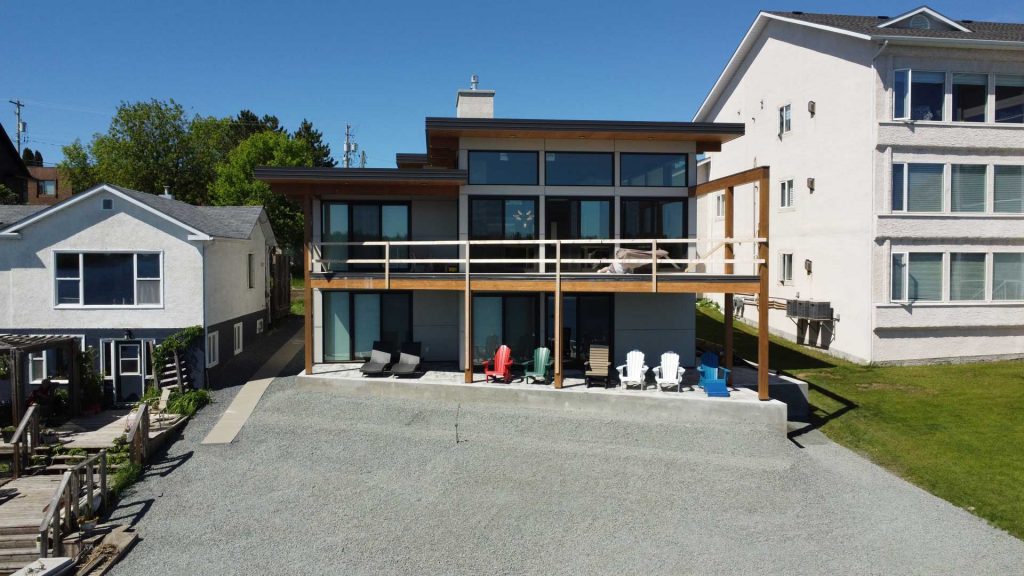
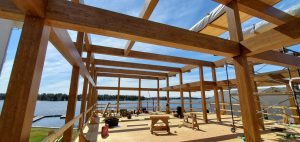
Ocean Avenue is a contemporary urban infill residence engineered around a laminated mass timber structural system. Unlike rural lake cottages where footprint expansion is often available, urban infill construction demands precision. Property line proximity, height restrictions, and limited staging area require a structurally disciplined approach.
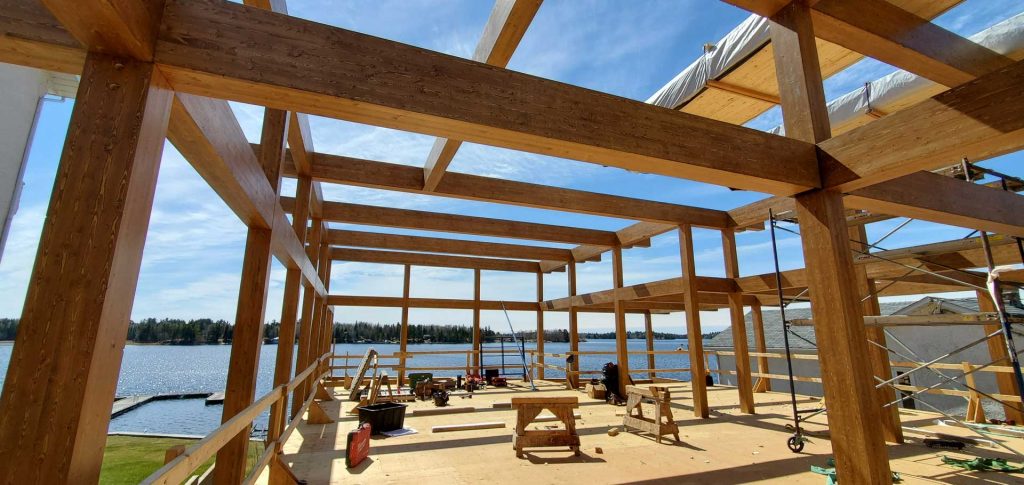
This residence utilizes Nordic Structure laminated columns and beams as the primary load-bearing frame. The system supports expansive lake-facing glazing while maintaining clean architectural lines and open interior volumes.
The aesthetic minimalism is a direct result of structural clarity rather than concealed reinforcement.
Laminated Columns and Beams: Predictable Structural Performance
The structural grid consists of engineered laminated timber members designed for dimensional stability and consistent strength characteristics.
Advantages of laminated timber columns and beams include:
-
High compressive strength parallel to grain
-
Predictable modulus of elasticity
-
Reduced natural defect variability compared to solid sawn lumber
-
Enhanced long-span capability
In urban infill conditions, vertical load stacking must align precisely. Laminated columns transfer roof and floor loads directly into foundation anchorage without eccentric deviation.
Large lake-facing glazing introduces concentrated header loads. Laminated beams spanning these openings are sized based on bending stress limits and allowable deflection under combined dead and live load.
Creep deformation is incorporated into design calculations to maintain long-term serviceability, especially in beams supporting sustained roof load.
Large Glazing Support and Envelope Integration
Expansive lake-facing glass requires structural precision. Window wall systems impose both vertical and lateral demands.
Structural considerations include:
-
Reinforced beam sizing over wide openings
-
Controlled deflection to protect glazing seals
-
Lateral shear resistance under wind load
-
Airtight connection detailing
Mass timber framing enables tight fabrication tolerances. Precise column and beam alignment reduces the need for field modifications and preserves envelope integrity.
Thermal bridging at connection points is mitigated through coordinated insulation detailing and continuous air barrier systems.
Engineered Timber Decking: 54 mm x 286 mm Structural Roof Deck
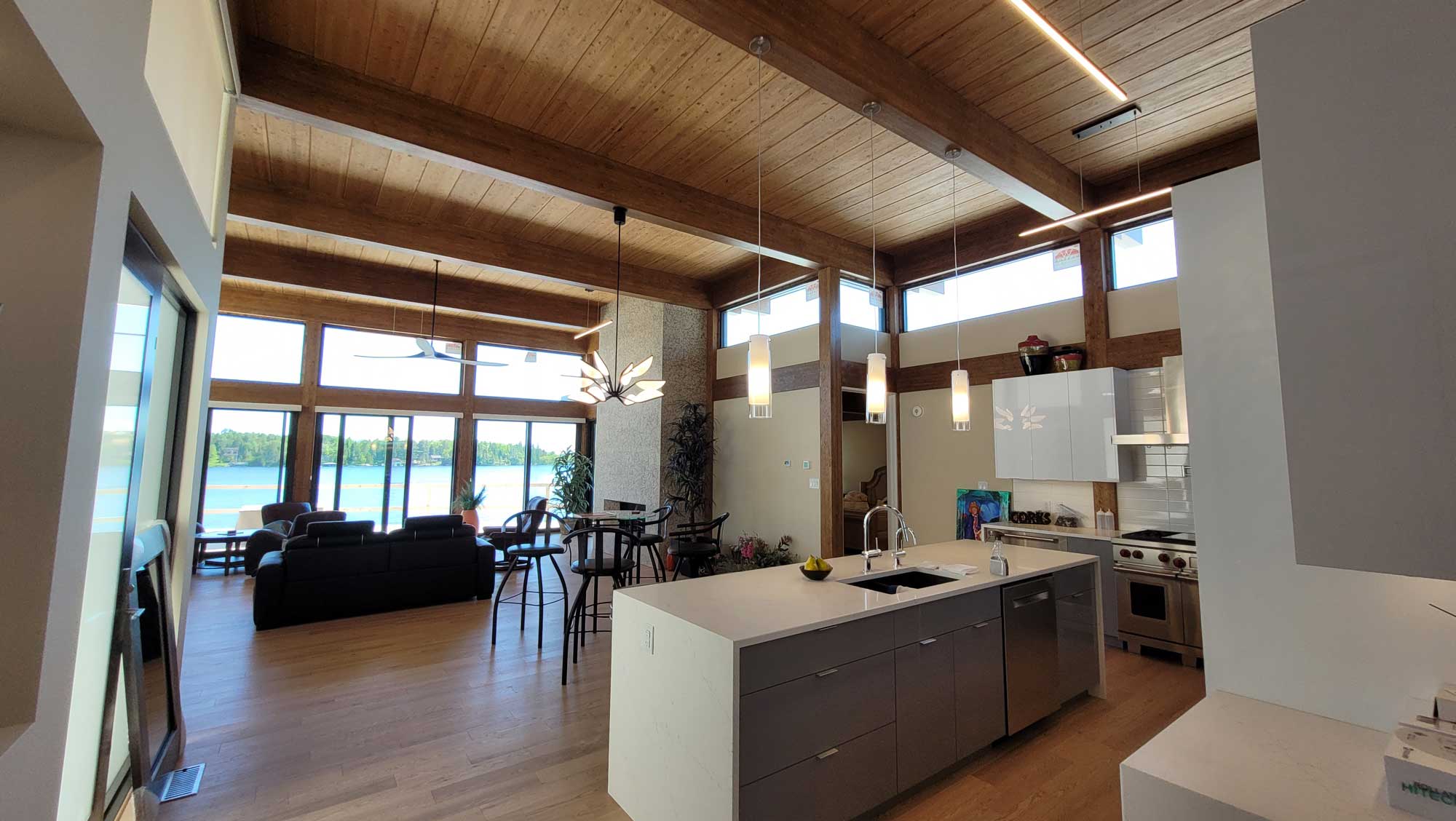
Interior ceilings are formed using Nordic 54 mm x 286 mm decking, approximately 2.1 in x 11.25 in. These structural deck panels serve dual functions:
-
Exposed interior ceiling finish
-
Structural roof diaphragm
As structural decking, these panels distribute roof load across supporting beams and contribute to lateral diaphragm stiffness.
Engineering benefits include:
-
High bending capacity across short spans
-
Uniform load transfer to primary beams
-
Strong nail base for insulation layers
The decking thickness provides sufficient structural depth to support insulation and roofing membrane above. Load calculations account for snow load, dead load from insulation, and roof membrane weight.
Proper fastening schedules ensure diaphragm integrity and limit shear displacement under lateral wind forces.
Roof Assembly and Moisture Control
The structural decking provides a continuous substrate for high-performance roof assemblies.
Key envelope considerations include:
-
Continuous insulation above deck
-
Vapor control layer placement
-
Waterproof membrane integration
-
Ventilation strategy to prevent condensation
Because mass timber panels are sensitive to prolonged moisture exposure, roof detailing must prevent hydrostatic pressure buildup during freeze-thaw cycles.
Dimensional stability of laminated decking reduces risk of joint separation and air leakage.
Urban Infill Load and Lateral Stability
Urban infill sites often require enhanced lateral resistance due to adjacent building constraints and limited setback distances.
Lateral stability is achieved through:
-
Diaphragm action of decking and floor systems
-
Shear walls integrated into mass timber panels
-
Steel hold-down anchors at foundation
Wind load calculations account for exposure category typical in urban lake-adjacent environments.
Continuous load paths from roof diaphragm to foundation ensure structural coherence.
Thermal Performance and Sustainability
Mass timber provides environmental benefits including:
-
Carbon sequestration within structural members
-
Reduced embodied energy relative to concrete or steel
-
Compatibility with continuous insulation strategies
While lighter than concrete, laminated decking contributes moderate thermal mass, buffering short-term temperature variation.
Energy performance depends on airtight detailing and insulation continuity. Structural penetrations are sealed to prevent convective heat loss.
Structural Summary
Ocean Avenue demonstrates how mass timber can define contemporary urban residential architecture through:
-
Laminated column and beam structural grid
-
Engineered decking serving as ceiling and diaphragm
-
Precise support of expansive lake-facing glazing
-
Tight integration between structure and envelope
The clean lines of the residence are a consequence of structural discipline. Laminated timber members provide predictable strength, dimensional stability, and refined visual presence.
This project illustrates how mass timber systems perform effectively in urban infill conditions, delivering structural reliability, architectural clarity, and long-term durability within constrained sites.